
Van payload: why a 3.5 tonne van cannot carry 3.5 tonnes
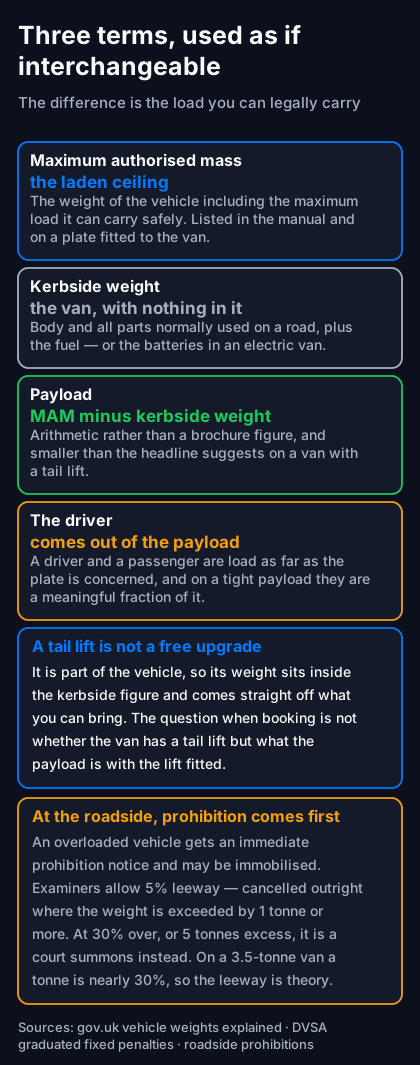
A 3.5 tonne van cannot carry 3.5 tonnes: the plated figure is the maximum authorised mass of the whole vehicle, and the van's own kerbside weight — including fuel, tail lift, racking and lining — comes out of it first. What is left is the payload. This sets out the three terms, how a tail lift reduces what you can bring, the 5% roadside leeway and the one-tonne rule that cancels it.
Why can't a 3.5 tonne van carry 3.5 tonnes?
Because the 3.5 tonnes is the whole vehicle, not the load. A van's headline figure is its maximum authorised mass — the weight of the vehicle including the maximum load it can carry safely — so the van's own weight comes out of that number before anything is loaded.
What is left is the payload, and on a long-wheelbase van with a tail lift it can be well under a third of the headline figure. The gap is where overloading comes from: nobody sets out to break the law, they just read the wrong number off the brochure.
Three terms do all the work here, and they are routinely used as if they were interchangeable. They are not, and the difference between them is the load you can legally put in.
What does maximum authorised mass mean?
It is the ceiling for the whole thing. Gov.uk defines maximum authorised mass as the weight of a vehicle or trailer including the maximum load that can be carried safely when it is being used on the road.
It is not a figure you calculate or negotiate. It is listed in the owner's manual and normally shown on a plate or sticker fitted to the vehicle, which makes it the one weight on this page that can be checked in thirty seconds by looking.
You will also see it written as gross vehicle weight, GVW, or permissible maximum weight. Same ceiling, different label — and the label on the plate is the one that counts at a roadside check.
What is kerbside weight?
The van with nothing in it but itself. Kerbside weight is the weight of the vehicle when it is not carrying any passengers, goods or other items, including the body and all parts normally used with the vehicle on a road.
Two inclusions in that definition surprise people. It includes the weight of the fuel — or, for an electric vehicle, the batteries — so a full tank is part of the van, not part of the allowance.
"All parts normally used with the vehicle" is the other one. A tail lift, racking, a bulkhead, a roof rack and a ply lining are all part of the van's own weight, which is why two vans with identical plates can have materially different payloads.
How do you work out the payload?
Subtract one from the other. Payload is the maximum authorised mass of the vehicle minus its unladen or kerbside weight — the difference between what the van weighs empty and what it is allowed to weigh loaded.
| Term | What it is | Where it comes from |
|---|---|---|
| Maximum authorised mass | The laden ceiling for the whole vehicle | The plate on the vehicle |
| Kerbside weight | The vehicle with fuel and fitted equipment, nothing else | The manual, or a weighbridge |
| Payload | MAM minus kerbside weight | Arithmetic, not a brochure figure |
| The driver | Comes out of the payload | Easy to forget entirely |
| Fitted equipment | Comes out of the payload | Tail lift, racking, lining |
The fourth row is the one that catches short jobs. A driver and a passenger are load as far as the plate is concerned, and on a van whose payload is already tight they are a meaningful fraction of it.
Does a tail lift reduce what you can carry?
Yes, and by more than most senders expect. A tail lift is part of the vehicle, so its weight is inside the kerbside figure and comes straight off the payload — the same van with and without one has two different carrying capacities.
That produces a genuine trade-off rather than a free upgrade. A tail lift is what makes a kerbside delivery possible without a forklift at the far end, and it buys that by reducing the weight you can bring.
So the right question when booking is not "does it have a tail lift?" but "what is the payload of the van with the tail lift on it?". Our who unloads article covers when you need the lift at all.
What happens at a roadside check?
The vehicle gets weighed and, if it is over, it stops being a legal vehicle on the spot. Gov.uk is direct about it: an overloaded vehicle is issued with an immediate prohibition notice and may be immobilised.
Officers can also direct the vehicle somewhere nearby where the load can be redistributed or removed. That is the practical outcome in most cases — not a fine in the post, but a van standing at the side of a road with a delivery on it that is not going anywhere.
Which makes overloading a schedule risk before it is a legal one. A prohibition in the middle of a multi-drop round ends the round, and the consignments behind it are late for reasons the sender cannot fix.
How much leeway is there?
A little, and it has a cut-out. DVSA examiners allow a 5% leeway before issuing a fixed penalty or prohibition — unless the relevant weight has been exceeded by 1 tonne or more, in which case the leeway does not apply.
- Under 5% over — examiners allow leeway before a penalty or prohibition.
- 1 tonne or more over — the leeway is cancelled regardless of the percentage.
- 30% or more over, or 5 tonnes excess — too serious for a fixed penalty, so a court summons is issued instead.
| How far over | What follows |
|---|---|
| Under 5% | Examiner leeway before a penalty or prohibition |
| 1 tonne or more over | Leeway cancelled, whatever the percentage |
| 30% or more over, or 5 tonnes excess | Court summons rather than a fixed penalty |
| Any overload, at the roadside | Immediate prohibition; possible immobilisation |
Note what the one-tonne rule does to a small vehicle. On a 3.5-tonne van, 1 tonne is nearly 30% of the plate, so the two thresholds converge and the leeway is largely theoretical — it is a rule written with lorries in mind.
Who is liable — the driver, the operator or the sender?
Enforcement lands on the vehicle and the operator, which is why a carrier will refuse a load rather than take it. But the weight that caused it came from the consignment, and the only party who knows what the consignment weighs before it is loaded is the sender.
That is the practical division. We can refuse, re-plan or send a different vehicle; what we cannot do is discover a pallet's real weight from the booking if the booking says something else.
So a declared weight is not an administrative field. It decides which vehicle is sent, and a wrong one produces either a refused collection on the day or a vehicle that should not be on the road.
What about weight on each axle?
A vehicle can be inside its total and still be illegal. Axle weights are plated separately, and a load concentrated at the back of a van can overload the rear axle while the overall figure looks comfortable.
This is the failure mode nobody checks for, because the arithmetic that most senders do — total load against payload — cannot detect it. Two pallets of equal weight placed differently give two different axle readings.
Loading heavy items forward of the rear axle and spreading the rest is what prevents it, which is the same discipline our load securing article describes for restraint: how the load sits decides more than what it weighs.
Does any of this change for a bigger vehicle?
The arithmetic is identical; only the numbers and the licence change. A 7.5-tonne or 18-tonne vehicle has the same three terms, a larger payload and additional obligations — drivers' hours, tachographs, operator licensing — that a 3.5-tonne van escapes.
That is why "send a bigger one" is not a free fix for a payload problem. Crossing 3.5 tonnes moves the job into a different regulatory class, and above 2.5 tonnes on international work it now also needs a tachograph — see our tachograph rules article.
And bigger is not automatically better in a city: access, weight restrictions and London's lorry safety permit all point the other way. When your load is too big for a van covers where the step up genuinely is the answer.
What should a sender actually check?
Four numbers, and all of them before booking rather than at collection.
- The real weight of the consignment, including the pallet and the packaging, not the net weight of the goods.
- How it is distributed — one dense item or spread across the deck.
- Whether a tail lift is needed, knowing it reduces the payload.
- Whether anyone is travelling with the load, since people come out of the payload too.
A weighbridge ticket settles the first one where the weight is genuinely unknown, and it is cheaper than a refused collection. Our pallet sizes and vehicle capacity article covers the dimensions side of the same question.
Where do we stand in this?
We choose the vehicle from what you tell us, and we will not load a van past its plate. A consignment that turns out heavier than booked means either a different vehicle or a second journey, and both are better outcomes than a prohibition.
What helps most is unglamorous: a real weight and an honest description at booking. That is the same request our load securing article makes for a different reason — the restraint required is a multiple of the weight, so an understated weight understates the straps as well.
For the vehicles themselves, see large van and van sizes compared; this page is the arithmetic that decides which of them turns up.
Questions
- Why can't a 3.5 tonne van carry 3.5 tonnes?
- Because the 3.5 tonnes is the whole vehicle, not the load. The plated figure is the maximum authorised mass — the weight of the vehicle including the maximum load it can carry safely — so the van's own weight comes out of it before anything is loaded. On a long-wheelbase van with a tail lift the remaining payload can be well under a third of the headline figure.
- What does maximum authorised mass mean?
- The weight of a vehicle or trailer including the maximum load that can be carried safely when it is being used on the road. It is not calculated or negotiated: it is listed in the owner's manual and normally shown on a plate or sticker fitted to the vehicle. You will also see it as gross vehicle weight, GVW or permissible maximum weight — the same ceiling under different labels.
- What is kerbside weight?
- The weight of the vehicle when it is not carrying any passengers, goods or other items, including the body and all parts normally used with the vehicle on a road. It includes the fuel — or the batteries in an electric vehicle — so a full tank is part of the van rather than part of the allowance. Fitted equipment counts too, which is why identical plates can mean different payloads.
- How do you calculate a van's payload?
- Maximum authorised mass minus the unladen or kerbside weight: what the van is allowed to weigh loaded, less what it weighs empty. Two things that come out of the payload and are routinely forgotten are the driver and any passenger, and fitted equipment such as a tail lift, racking, bulkhead or ply lining — all of which sit inside the kerbside figure.
- Does a tail lift reduce the payload?
- Yes, and by more than most senders expect, because the lift is part of the vehicle and its weight sits inside the kerbside figure. The same van with and without one has two different carrying capacities. That makes it a trade-off rather than a free upgrade: the right question when booking is not whether the van has a tail lift but what the payload is with the lift fitted.
- What happens if a van is overloaded at a roadside check?
- An overloaded vehicle is issued with an immediate prohibition notice and may be immobilised, and officers can direct it somewhere nearby to redistribute or remove the load. That is the usual outcome — not a fine in the post but a van stopped at the roadside with an undeliverable load on it, which makes overloading a schedule risk before it is a legal one.
- How much overloading leeway do DVSA examiners allow?
- Examiners allow a 5% leeway before issuing a fixed penalty or prohibition, unless the relevant weight has been exceeded by 1 tonne or more, which cancels it. At 30% or more over, or 5 tonnes excess, the case is too serious for a fixed penalty and a court summons is issued instead. On a 3.5-tonne van a tonne is nearly 30% of the plate, so for vans the leeway is largely theoretical.
Explore more
More from the blog
- Simpler Recycling: what a workplace must separate,…
- Tachographs: who needs one, and the van rule that c…
- Temperature mapping: what it establishes, and whose…
- UN3480 vs UN3481: which number applies to your lith…
- What a Van Can Legally Carry: Gross Vehicle Weight,…
- Waste carrier registration: who needs one, and what…