
Temperature mapping: what it establishes, and whose obligation it is
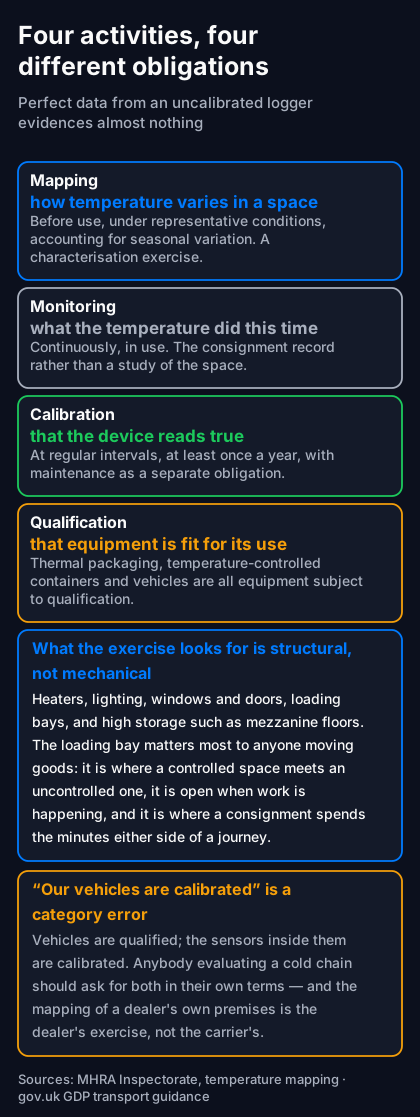
Temperature mapping establishes what the temperature actually does across a space, as opposed to what the thermostat reports. It happens before an area is used, under representative conditions, and has to take seasonal variation into account. It is not monitoring, calibration is not qualification, and the obligation sits with the business whose quality system covers the premises — not with the carrier. This sets out the distinctions and who owes which exercise.
What is temperature mapping?
Temperature mapping is the exercise that establishes what the temperature actually does across a space, rather than what a thermostat says it should do. Sensors are placed throughout the area, left to record under real conditions, and the resulting picture shows where it is warmest, coldest and least stable.
It answers a question a single thermometer cannot. A cold room holding its set point at the sensor on the wall can be several degrees different at the ceiling, by the door, or against a wall that catches afternoon sun, and only a map shows that.
So mapping is a characterisation exercise. It produces evidence about a place, which is then used to decide where product may and may not be kept.
When does it have to happen?
Before the area is used. The MHRA Inspectorate puts it as an initial temperature mapping exercise carried out on the storage area before use, under representative conditions, so that the company understands its storage area and identifies any potential areas unsuitable for storing medicines.
"Before use" is the part that gets compressed when a site is commissioned in a hurry. Mapping after stock has moved in tells you about a space that is already holding product, which is evidence collected too late to act on cleanly.
"Representative conditions" does equivalent work. An empty room with the doors shut maps differently from a working one with pickers in and out, so a map produced in ideal conditions describes a building that does not exist.
What is the exercise looking for?
Places where the air is not doing what the specification assumes. The guidance names the usual suspects, and they are all structural rather than mechanical.
| What to look for | Why it matters |
|---|---|
| Heaters | Local warm zones that the control sensor never sees |
| Lighting | Radiant heat close to the fitting, often at the top of racking |
| Windows and doors | Solar gain and draughts, both time-dependent |
| Loading bays | The least controlled part of any temperature-controlled site |
| High storage, such as mezzanine floors | Stratification — warm air sits at the top |
The loading bay is the one that matters most to anybody moving goods. It is where a controlled space meets an uncontrolled one, it is open when work is happening, and it is where a consignment spends the minutes either side of a journey.
Why do the seasons matter?
Because a building behaves differently in February and August, and one map does not describe both. Gov.uk's GDP guidance on transport requires mapping under representative conditions taking seasonal variations into account.
That has a practical consequence: a mapping exercise is not a single afternoon's work finished forever. A summer map and a winter map answer different questions, and the hot case usually sets the limit.
It also means a site that passed in spring is not evidenced for July. The same is true of vehicles, which is why a van that holds temperature comfortably in October is not thereby qualified for a heatwave.
Is mapping the same as monitoring?
No, and conflating them is the commonest error in this subject. Mapping characterises a space once, under controlled study; monitoring records what happened to a consignment or an area continuously, during use.
| Activity | What it establishes | When |
|---|---|---|
| Mapping | How temperature varies across a space | Before use, and on change |
| Monitoring | What the temperature did on this occasion | Continuously, in use |
| Calibration | That the measuring device reads true | At intervals, at least annually |
| Qualification | That equipment is fit for its intended use | Before use, and on change |
Those four are separate obligations with separate evidence. A business can hold perfect monitoring data from an uncalibrated logger in an unmapped room and have evidenced almost nothing.
Is calibration the same as qualification?
No. Calibration is about the instrument; qualification is about the equipment doing the job. A calibrated probe tells you its reading is trustworthy; it says nothing about whether the container around it can hold a temperature for eight hours in traffic.
The guidance treats them that way. Thermal packaging, temperature-controlled containers and temperature-controlled vehicles are described as equipment subject to qualification, to be used so that correct transport conditions are maintained.
So the sentence "our vehicles are calibrated" is a category error. Vehicles are qualified; the sensors inside them are calibrated, and anybody evaluating a cold chain should be asking for both in their own terms.
Does a vehicle need mapping?
Where it is being relied on to hold a temperature, yes — the same logic applies to the load space as to a room. Mapping under representative conditions, taking seasonal variation into account, is specified for transport equipment rather than for buildings alone.
A load space is a harder case than a cold room, because it changes shape. A fully laden van and a nearly empty one have different airflow, so the warm spot moves with the loading pattern, and a door opened at every drop resets the exercise.
Which is why multi-drop temperature-controlled work is the demanding version. A single point-to-point run has two door events; a twelve-drop round has twenty-four, and every one of them is an excursion opportunity.
It is also why the words used for the service matter. A refrigerated vehicle holds a temperature; a cold chain is an evidenced sequence in which every link is known and recorded, and the two are sold under similar names. Our cold chain versus temperature-controlled comparison separates them, and temperature-controlled versus ambient covers the step before that — whether the consignment needs control at all, which is a product question rather than a transport one and is answered by the product's own documentation.
Whose obligation is it?
The business whose quality system covers the product and the premises — in medicines, the wholesale dealer. Mapping and qualification are exercises performed on a space or a piece of equipment by whoever operates it, under that quality system.
A carrier is not outside the arrangement, but it is not the duty holder either. It is assessed by the dealer, and what it supplies is transport under agreed conditions plus the record proving what happened.
That division is worth stating in a contract rather than assuming. Our cold chain validation entry covers the wider validation picture and temperature mapping defines the term; the gap this page fills is who owes which exercise.
How often is monitoring equipment calibrated?
At least once a year. Equipment used for temperature monitoring during transport, in vehicles or containers, has to be maintained and calibrated at regular intervals, at least annually.
- A calibration record for each monitoring device, current rather than historic.
- Maintenance, which is a separate obligation from calibration.
- Intervals that are defined, with "at least once a year" as the floor rather than the target.
An expired calibration certificate does not invalidate the journey retrospectively, but it does remove the evidence that the reading was true — which, for a consignment whose acceptability turns on the reading, amounts to much the same thing.
What does a carrier get asked for?
Four things, in our experience of being asked, and none of them is a mapping report.
- The temperature record for the consignment, legible and attributable to it.
- Calibration evidence for the device that produced it.
- What happens on an excursion — who is told, how quickly, and what is done with the goods.
- Who else handled it, since a chain with an unidentified link is not evidenced.
The third is the one that separates a cold chain from a refrigerated vehicle. A van that holds temperature is necessary; a process that notices when it stops is what makes the record worth keeping.
Worth noting what is not usually asked for: a mapping report from the carrier. Dealers assessing a transport provider ask about the consignment record and the monitoring behind it, because the mapping of their own premises is their exercise and the qualification of hired equipment belongs to whoever operates it. A carrier offering a mapping report has either done something unusual or is describing something else — see temperature-controlled delivery for what the transport side of this actually consists of, and the pharmaceutical cold chain for how the pieces fit together end to end.
Where do we stand in this?
Plainly: we are not a wholesale dealer, we hold no GDP certification, and mapping, qualification and validation are not exercises we perform. Those belong to the business operating the premises or the equipment, under its own quality system.
What we do is carry temperature-controlled consignments and produce the record for them, and where a movement needs qualified equipment and a validated chain, that is arranged with a partner operating under its own authorisation rather than claimed here.
The useful thing we can add is upstream of all of it. Most excursions we are asked about happened at a door rather than on a road — at the loading bay, during a wait, or between a handover and a vehicle. Our who unloads article covers who is responsible at that boundary, and clinical trial logistics the version of this problem where the chain of custody matters as much as the temperature.
Questions
- What is temperature mapping?
- The exercise that establishes what temperature actually does across a space, rather than what a thermostat says it should do. Sensors are placed throughout the area, left to record under real conditions, and the resulting picture shows where it is warmest, coldest and least stable. A cold room holding its set point at the wall sensor can be several degrees different at the ceiling, by the door, or against a sunlit wall.
- When does temperature mapping have to be done?
- Before the area is used. The MHRA Inspectorate describes an initial mapping exercise carried out on the storage area before use, under representative conditions, so the company understands its storage area and identifies areas unsuitable for storing medicines. Mapping after stock has moved in is evidence collected too late to act on, and mapping an empty room with the doors shut describes a building that does not exist.
- What does a mapping exercise look for?
- Structural rather than mechanical problems: heaters creating local warm zones the control sensor never sees, lighting giving off radiant heat at the top of racking, windows and doors bringing solar gain and draughts, loading bays as the least controlled part of the site, and high storage such as mezzanine floors where warm air stratifies. The loading bay matters most to anyone moving goods.
- Why does temperature mapping have to account for seasons?
- Because a building behaves differently in February and August, and one map does not describe both. GDP guidance requires mapping under representative conditions taking seasonal variations into account. A summer map and a winter map answer different questions and the hot case usually sets the limit — so a site that passed in spring is not evidenced for July, and nor is a van.
- Is temperature mapping the same as monitoring?
- No, and conflating them is the commonest error here. Mapping characterises a space once, under controlled study; monitoring records what happened to a consignment or area continuously, during use. Calibration establishes that the measuring device reads true, and qualification that equipment is fit for its intended use. A business can hold perfect monitoring data from an uncalibrated logger in an unmapped room and have evidenced almost nothing.
- Is calibration the same as qualification?
- No. Calibration is about the instrument; qualification is about the equipment doing the job. A calibrated probe tells you its reading is trustworthy but says nothing about whether the container around it holds temperature for eight hours in traffic. Thermal packaging, temperature-controlled containers and temperature-controlled vehicles are equipment subject to qualification, so “our vehicles are calibrated” is a category error.
- How often must temperature monitoring equipment be calibrated?
- At least once a year. Equipment used for temperature monitoring during transport, in vehicles or containers, must be maintained and calibrated at regular intervals, at least annually — and maintenance is a separate obligation from calibration. An expired certificate does not invalidate a past journey, but it removes the evidence that the reading was true, which for a consignment judged on that reading amounts to much the same thing.
Explore more
More from the blog
- Inland border facilities: what they do, and what ch…
- IOSS: who collects the EU VAT on a low-value parcel
- IPAFFS pre-notification: what the border needs befo…
- ISPM 15: when your pallet needs a stamp, and when i…
- Kerbside, tail lift or carried in: who unloads, and…
- Known consignor, regulated agent and screening: who…