
IOSS: who collects the EU VAT on a low-value parcel
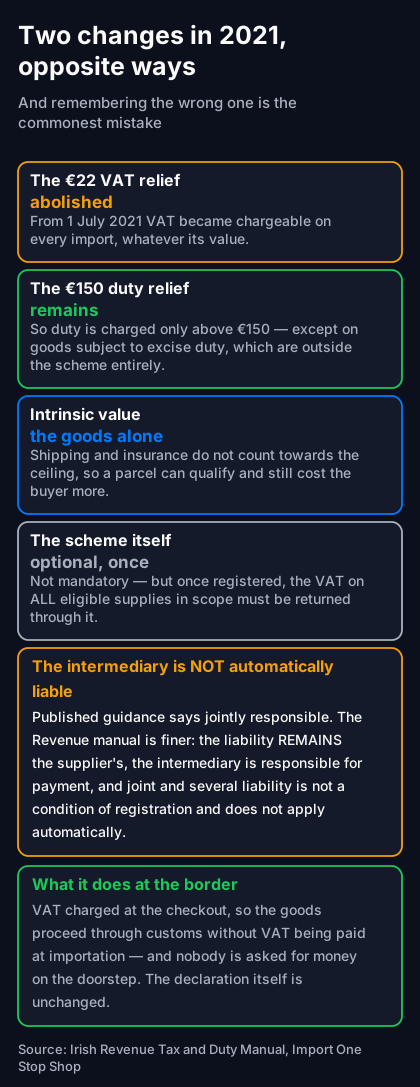
The Import One Stop Shop lets a seller outside the EU charge EU VAT at the checkout and account for it in one monthly return, so the parcel clears customs without VAT being collected from the recipient. It covers consignments whose intrinsic value does not exceed €150, excluding excise goods, and a UK seller needs an EU-established intermediary to use it. This sets out what it covers, what changed in 2021, and who is actually liable for the VAT.
What is the Import One Stop Shop?
The Import One Stop Shop is an EU scheme that lets a seller outside the EU charge EU VAT at the checkout and account for it in one monthly return, instead of the VAT being collected from the customer when the parcel arrives. It is a VAT mechanism, not a customs one.
The Irish Revenue manual on the scheme puts its purpose in one line: it allows for the declaration and payment of EU VAT due on import through a monthly IOSS return instead of the payment of the VAT to Customs at the time of importation of the goods.
One registration covers the lot. A supplier registers in a single member state and reports all supplies within the scheme's scope across the EU through that one registration — which is the whole appeal, because the alternative is dealing with twenty-seven tax authorities.
What does it cover, and what does it exclude?
Low-value consignments of non-excise goods, dispatched from outside the EU. Three conditions have to hold together, and the manual states them as a single test.
| Condition | Detail |
|---|---|
| Value | The intrinsic value of the consignment does not exceed €150 |
| Goods | Excluding goods subject to excise duty |
| Dispatch | By or on behalf of the supplier, from outside the EU at the time of supply |
Intrinsic value is the goods alone. Shipping and insurance are not counted towards the ceiling, which means a consignment can sit inside the scheme on goods value and still cost the buyer appreciably more than the threshold once carriage is added.
The excise exclusion is absolute rather than a matter of degree, so alcohol and tobacco consignments are outside the scheme whatever they are worth. Our EMCS article covers how excise goods move instead.
Is it compulsory?
No, and the conditional half of that answer matters more than the first. The manual states that use of the scheme is not mandatory — but that once registered for it, the VAT due on all eligible supplies within scope must be returned through the scheme.
So the choice is made once, at registration, rather than per shipment. A seller cannot run IOSS for the orders where it is convenient and leave the rest to be taxed at the border, which is how some sellers imagine it works and is the quickest route to an inconsistent return.
What a seller can do is decide not to register at all, and accept the pre-2021 arrangement: the VAT is collected on importation, from the customer, with whatever handling charge the carrier applies for doing it.
What changed on 1 July 2021?
Two things, in opposite directions, and conflating them is the commonest misunderstanding in this area.
- The low-value VAT exemption went. The relief for consignments under €22 was abolished, and VAT became chargeable on all imports regardless of value.
- The customs duty relief stayed. The exemption from customs duty for goods with an intrinsic value of less than €150 remains in place.
So after that date VAT is due on everything and duty only above €150, except for goods subject to excise duty. A seller who remembers "small parcels are exempt" is remembering the VAT rule that was abolished, not the duty rule that survived.
The UK operates its own low-value threshold on imports into Britain, and it is a different figure under a different scheme. Treating the EU ceiling as though it applied in both directions is a mistake worth naming, because the paperwork follows the destination rather than the seller.
Who can be an intermediary?
Someone established in the EU, and this is where a UK seller's path narrows. The manual defines an intermediary as a person that has their business establishment or a fixed establishment in the EU and represents a taxable person for the purpose of the scheme — and states that a person with no establishment in the EU cannot act as an intermediary.
Since the UK is outside the EU for this purpose, a British seller wanting to use the scheme needs an EU-established intermediary rather than registering alone. That is a commercial appointment with due diligence attached: an intermediary registered in Ireland is expected to engage in standard risk management practices such as customer due diligence, and to tell Revenue where it has concerns about a taxable person it represents.
The role is to fulfil the scheme's obligations on the supplier's behalf, including the declaration and payment of the VAT due on importation of goods with an intrinsic value not exceeding €150.
Is the intermediary liable for the VAT?
Not automatically, and the open web gets this wrong. Published guidance routinely says the intermediary is jointly responsible for the VAT; the manual draws a finer line.
The VAT liability remains the liability of the supplier represented by the intermediary, while the intermediary is responsible for payment of the VAT due. Joint and several liability is a separate step: Revenue may hold the intermediary jointly and severally liable where it deems that necessary for the protection of the revenue, a notice then issues to both parties, and it applies on a prospective basis.
The manual is explicit that joint and several liability is not a condition of registration as an intermediary and does not apply automatically. For anyone negotiating with an intermediary, that is the difference between a service and an open-ended guarantee — and it is worth quoting rather than paraphrasing.
What does it mean for the parcel at the border?
It clears without a VAT payment, which is the operational point of the whole scheme. Where the scheme is used, the seller charges VAT at the applicable rate at the point of sale, with the result that goods proceed through customs without the need for VAT to be paid at the point of importation.
The mechanism is the IOSS number travelling in the customs data. The parcel still needs a customs declaration and still needs correct commodity codes and a commercial invoice; what it does not need is the collection of VAT from the recipient before release.
That removes the single worst experience in cross-border retail: a customer being asked for money by a delivery driver for a purchase they believed was paid for. It also removes the handling fee that usually accompanies it.
What it does not remove is the declaration itself. A consignment under the scheme is still an import, still classified, still described, and still capable of being held for any of the reasons an import can be held — a missing licence, an SPS requirement, an inconsistent invoice. The scheme settles who collects one tax, and nothing else about the border.
What happens if you do not use it?
The VAT is collected at importation instead, and somebody pays to collect it. That is the pre-2021 arrangement and it still operates, with three consequences a seller feels rather than reads about.
| With the scheme | Without it |
|---|---|
| VAT charged at checkout | VAT collected on importation |
| Parcel clears without a VAT payment | Parcel held until the recipient pays |
| One monthly return | No return, but a handling charge per parcel |
| Price at checkout is the final price | Final price is unknown until delivery |
Unlike a duty question, which turns on the goods, this one turns on the terms of sale. A seller shipping on delivered-duty-paid terms carries the charges either way; one shipping delivered-at-place leaves them with the buyer, which is where the refused-delivery rate comes from. Our Incoterms article covers which term puts the charges where.
What does a carrier need to know?
Three facts, none of which is the VAT rate.
- Whether the consignment is travelling under the scheme, because that decides whether anyone needs to collect money on delivery.
- Whether the value is inside the ceiling, since a consignment over it needs ordinary import treatment regardless of registration.
- Whether the goods are excise goods, which puts them outside the scheme whatever they are worth.
Those three decide the shape of the delivery rather than the tax. A parcel the recipient has to pay for before release is a different job from one that does not — it needs a payment mechanism, a second attempt and a refusal process — and that difference belongs in the booking, not in the driver's day.
What is our part in this?
None of the tax, and we should say so plainly: we are a carrier, not a tax agent and not an intermediary, and we do not register anybody for the scheme or file anybody's return.
It appears here because it decides what happens at the door. Our work on this corridor is road freight and dedicated movements rather than parcel networks, so the usual pattern is a business-to-business consignment where the import VAT is handled through the importer's own accounting — see import VAT and postponed VAT accounting for the inbound equivalent. Our European road freight page sets out the movements.
For the paperwork that travels either way, see commercial invoices, proof of origin and, where the goods are moving under transit rather than being imported, NCTS.
Questions
- What is the Import One Stop Shop?
- An EU scheme that lets a seller outside the EU charge EU VAT at the checkout and account for it through one monthly return, instead of the VAT being collected from the customer when the parcel arrives. One registration in a single member state covers supplies across the EU within the scheme's scope, which is the appeal — the alternative is dealing with twenty-seven tax authorities separately.
- What does IOSS cover?
- Consignments whose intrinsic value does not exceed €150, excluding goods subject to excise duty, dispatched by or on behalf of the supplier from outside the EU at the time of supply. All three conditions have to hold. Intrinsic value is the goods alone, so shipping and insurance do not count towards the ceiling — a consignment can qualify on goods value and still cost the buyer more than the threshold once carriage is added.
- Is IOSS compulsory?
- No, but the choice is made once rather than per shipment. Use of the scheme is not mandatory; however, once registered, the VAT due on all eligible supplies within its scope must be returned through it. A seller cannot run the scheme for convenient orders and leave the rest to be taxed at the border. Not registering at all is allowed, and leaves the pre-2021 arrangement of VAT collected on importation.
- What changed for low-value parcels in July 2021?
- Two things, in opposite directions. The VAT relief for consignments under €22 was abolished, so VAT became chargeable on all imports regardless of value. The customs duty relief for goods with an intrinsic value under €150 remained. So VAT is due on everything and duty only above €150, except for excise goods — and a seller who remembers that small parcels are exempt is remembering the rule that went, not the one that stayed.
- Can a UK seller use IOSS without an intermediary?
- No. An intermediary must have a business establishment or fixed establishment in the EU, and a person with no EU establishment cannot act as one. Since the UK is outside the EU for this purpose, a British seller needs an EU-established intermediary to use the scheme. That is a commercial appointment with due diligence attached — an intermediary is expected to carry out customer due diligence on the suppliers it represents.
- Is an IOSS intermediary liable for the VAT?
- Not automatically, and most published guidance overstates this. The VAT liability remains the supplier's; the intermediary is responsible for payment of the VAT due. Joint and several liability is a separate step that a revenue authority may impose where it deems that necessary to protect the revenue, by notice to both parties and on a prospective basis. It is explicitly not a condition of registration and does not apply automatically.
- What happens to a parcel if the seller does not use IOSS?
- The VAT is collected at importation instead, so the parcel is held until the recipient pays, usually with a handling charge on top, and the final price is unknown until delivery. Which party ends up carrying that depends on the terms of sale rather than on the goods: a seller shipping on delivered-duty-paid terms absorbs it either way, while delivered-at-place leaves it with the buyer — which is where refused deliveries come from.
Explore more
More from the blog
- UN3480 vs UN3481: which number applies to your lith…
- What a Van Can Legally Carry: Gross Vehicle Weight,…
- Waste transfer notes and the duty of care: which do…
- Great Britain to Northern Ireland: what the rules a…
- Our Certifications & Compliance Framework
- UK Same-Day Courier: The Complete 2026 Guide for Bu…