
Tachographs: who needs one, and the van rule that changed in 2026
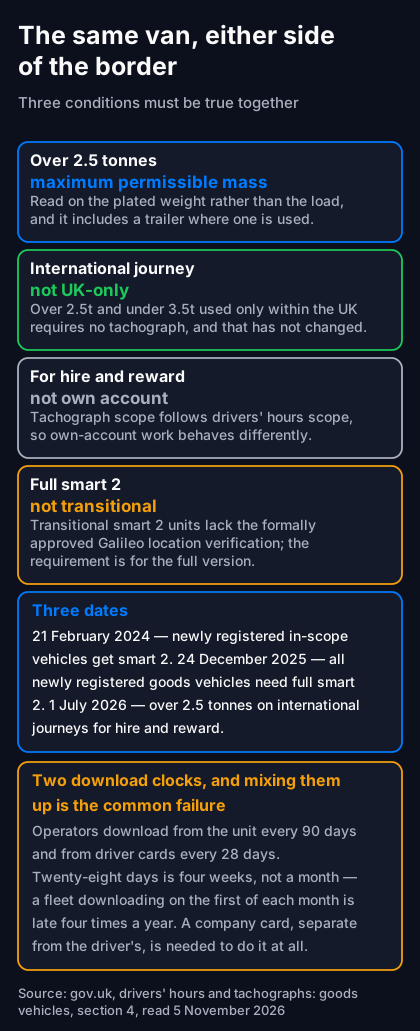
A tachograph records driving time, breaks and, in the current generation, position. Since 1 July 2026 goods vehicles over 2.5 tonnes used for international journeys for hire and reward have needed a full smart 2 tachograph — which brought ordinary 3.5-tonne vans into scope. The same van on UK-only work still needs none. This sets out the thresholds, the dates, the driver card rules and the download clocks.
What does a tachograph record?
A tachograph is the recording equipment that logs what a vehicle and its driver did: driving time, other work, breaks and rest, and the distance and speed involved. It exists so that drivers' hours rules can be checked after the event rather than taken on trust.
A smart tachograph adds position data to that record. It is no longer only a question of how long somebody drove, but of where the vehicle was when it happened.
The record is the point of the device. A perfectly compliant driver with no usable record is in the same position at the roadside as a non-compliant one, which is why the download obligations further down this page matter as much as the fitting.
Which vehicles must have one?
Historically, goods vehicles over 3.5 tonnes. That threshold has moved, and it moved in a way that catches vans rather than lorries.
| From | What it requires |
|---|---|
| 21 February 2024 | All newly registered in-scope vehicles have smart 2 tachographs fitted |
| 24 December 2025 | All newly registered goods vehicles require full smart 2 tachographs |
| 1 July 2026 | Goods vehicles over 2.5 tonnes used for international journeys for hire and reward must have full smart 2 tachographs fitted |
Read the last row carefully, because three conditions have to be true together: over 2.5 tonnes, international, and for hire and reward. Change any one of them and the answer changes.
What changed on 1 July 2026?
Vans came into scope on international work. Gov.uk puts it as goods vehicles over 2.5 tonnes used for international journeys for hire and reward needing full smart 2 tachographs from that date.
For most commercial fleets that means the 3.5-tonne van — the standard long-wheelbase panel van or Luton, which sits comfortably above 2.5 tonnes gross. A vehicle that needed no tachograph for a run to Rotterdam in June 2026 needed one in July.
It is a fitting requirement rather than a paperwork one, which is what makes it expensive to discover late. A tachograph has to be installed and calibrated by an approved centre; it is not something that can be arranged the afternoon before a sailing.
The weight test is read on the maximum permissible mass rather than on what is in the back, and it includes a trailer where one is used. So a van that routinely runs part-loaded is measured by what it is allowed to weigh, not by what it does weigh on the day, and a small trailer can take a vehicle over the line on its own. Checking the plated weight is a two-minute job that settles the question for the whole fleet rather than per journey.
Does a 3.5 tonne van need one in the UK?
No. Goods vehicles weighing over 2.5 tonnes and less than 3.5 tonnes used only within the UK do not require tachographs, and that has not changed.
| Same van, different work | Tachograph? |
|---|---|
| UK domestic, over 2.5t and under 3.5t | No |
| International, over 2.5t, hire and reward | Yes — full smart 2 |
| Over 3.5 tonnes, UK or international | Yes, as before |
So the same vehicle, the same driver and the same load can fall either side of the requirement depending on whether the delivery address is in Birmingham or Bruges. That is an unusual shape for a vehicle rule, and it is why fleets that do occasional European work are the ones most likely to be caught out.
It also makes the first European job the decision point. A fleet that has never left the UK has no reason to have thought about any of this, and the honest answer to "can you take a van over?" depends on whether that fitting has already happened.
What is a smart 2 tachograph?
The current generation, and it records more than its predecessors. Smart 2 units have enhanced functionality beyond smart 1, including automatic border crossing recording and vehicle location recording.
Automatic border crossing recording is the feature with consequences. A driver no longer has to record a crossing manually, and the unit's version of events is the one that exists — which removes an argument and also removes a margin.
There is a distinction worth knowing inside the generation: transitional smart 2 tachographs do not have the formally approved location verification facilities, known as Galileo, in their software. A unit described as smart 2 is not automatically a full smart 2, and the 1 July 2026 requirement is for the full version.
Which vehicles are exempt?
Those outside the drivers' hours rules in the first place. Drivers of vehicles exempt from the assimilated and AETR rules are not required to use tachographs — with one named exception: vehicles operated by universal service providers, currently Royal Mail only.
The structure matters more than the list. Tachograph scope follows drivers' hours scope, so the question "do I need a tachograph?" is downstream of "am I in scope for drivers' hours?" rather than a separate test.
Which is why own-account work behaves differently from hire and reward, and why the international van rule is written around carriage for hire and reward specifically. Our own transport versus a courier comparison covers the drivers' hours side of that distinction for a business considering driving the load itself.
What does a driver need?
A personalised card, and only one of them. Drivers must use their own driver cards when operating a vehicle fitted with a digital or smart tachograph, may not use anybody else's, and may not hold more than one card.
- A driver card in their own name, used in the vehicle they are driving.
- Not somebody else's card, which is a straightforward offence rather than an administrative slip.
- Not a second card, held in reserve or otherwise.
- Competence in using the unit, since a misused tachograph produces a defective record.
The single-card rule exists because two cards would let one driver's hours be split between two records. It is the kind of rule whose breach looks clerical and reads as deliberate.
How often must data be downloaded?
Two different clocks, and mixing them up is the commonest administrative failure here. Operators must download data from digital and smart tachographs every 90 days, and from driver cards every 28 days.
Twenty-eight days is four weeks, not a month, which means the obligation drifts against a calendar-month routine. A fleet downloading on the first of each month is late four times a year without anything appearing to go wrong.
The downloads also need a company card to perform. That is a separate card from the driver's, held by the operator, and a fleet that has fitted the units and not obtained one has the equipment without the means to discharge the obligation.
How does this sit with drivers' hours?
The tachograph is the evidence; drivers' hours are the rule. Bringing a van into tachograph scope on international work brings the hours regime with it, which is a bigger operational change than fitting a box.
In practice that reshapes the schedule rather than the paperwork. A route planned around a driver's working day has to be planned around prescribed breaks and daily limits instead, and those limits do not care that the vehicle is small. Our drivers' hours and your delivery window article sets out how that constrains a delivery slot.
It also interacts with the rules on where a foreign vehicle may work. Cabotage limits what a UK vehicle may do inside the EU after its international journey, and cabotage covers the term itself.
What does a customer actually need to ask?
Whether the specific vehicle is equipped, not whether the carrier is aware of the rule. Fitting is per vehicle: a fleet can be entirely compliant and still not have a compliant van free on the day.
- Is the vehicle fitted with a full smart 2 unit, calibrated by an approved centre?
- Is the journey international and for hire and reward? Both have to be true for the requirement to bite.
- Is the gross weight over 2.5 tonnes? Including, where relevant, a trailer.
- Who is driving? A driver card and competence are as necessary as the unit.
Those four questions take a minute and settle whether a European job can lawfully run. Asking them after the goods are loaded settles nothing useful.
Where do we stand in this?
We run vans, which is exactly the fleet this change reached. A UK domestic job in a van over 2.5 tonnes and under 3.5 needs no tachograph; a European job for hire and reward in the same van does, and that is a question about the individual vehicle rather than about the company.
So the honest answer to a European enquiry is a vehicle-level one, and it is worth asking for rather than assuming either way. Our international shipping page covers the work and UK to EU shipping the paperwork that travels with it.
What we do not do is advise on fleet compliance or fit equipment. The tachograph entry defines the device, this page covers who needs one, and the operator of each vehicle answers for its own.
Questions
- What does a tachograph record?
- Driving time, other work, breaks and rest, and the distance and speed involved — so that drivers' hours rules can be checked after the event rather than taken on trust. A smart tachograph adds position data, so it is no longer only a question of how long somebody drove but of where the vehicle was. A compliant driver with no usable record is in the same position at the roadside as a non-compliant one.
- Does a 3.5 tonne van need a tachograph?
- It depends on the journey. Goods vehicles over 2.5 tonnes and under 3.5 tonnes used only within the UK do not require tachographs. Since 1 July 2026, the same van on an international journey for hire and reward does — a full smart 2 unit. So the same vehicle, driver and load can fall either side of the requirement depending on whether the delivery address is in Birmingham or Bruges.
- What changed for tachographs on 1 July 2026?
- Vans came into scope on international work: goods vehicles over 2.5 tonnes used for international journeys for hire and reward must have full smart 2 tachographs fitted. For most fleets that means the standard 3.5-tonne panel van or Luton. It is a fitting requirement rather than a paperwork one — installation and calibration happen at an approved centre, not the afternoon before a sailing.
- What is a smart 2 tachograph?
- The current generation, with enhanced functionality beyond smart 1 including automatic border crossing recording and vehicle location recording. There is a distinction inside the generation: transitional smart 2 units do not have the formally approved location verification facilities, known as Galileo, in their software. A unit described as smart 2 is not automatically a full smart 2, and the 2026 requirement is for the full version.
- Which vehicles are exempt from tachograph rules?
- Those outside the drivers' hours rules in the first place: drivers of vehicles exempt from the assimilated and AETR rules are not required to use tachographs, with one named exception — vehicles operated by universal service providers, currently Royal Mail only. Tachograph scope follows drivers' hours scope, so the question is downstream of whether you are in scope for hours at all.
- How often does tachograph data have to be downloaded?
- Two different clocks: operators must download data from digital and smart tachographs every 90 days, and from driver cards every 28 days. Twenty-eight days is four weeks rather than a month, so the obligation drifts against a calendar-month routine — a fleet downloading on the first of each month is late four times a year. A company card, separate from the driver's, is needed to perform the downloads.
- Can a driver hold more than one tachograph card?
- No. Drivers must use their own personalised driver card in a vehicle fitted with a digital or smart tachograph, may not use anybody else's, and may not hold more than one. The single-card rule exists because two cards would let one driver's hours be split between two records — a breach that looks clerical and reads as deliberate.
Explore more
More from the blog
- Duty deferment accounts: paying import duty and VAT…
- EMCS: how a duty-suspended excise movement actually…
- EORI Number Explained: GB, XI, and Who Actually Nee…
- EPR for packaging: who is obligated, what they repo…
- EUDR: what the EU Deforestation Regulation asks of…
- GVMS and the Goods Movement Reference Explained