
EUDR: what the EU Deforestation Regulation asks of UK shippers
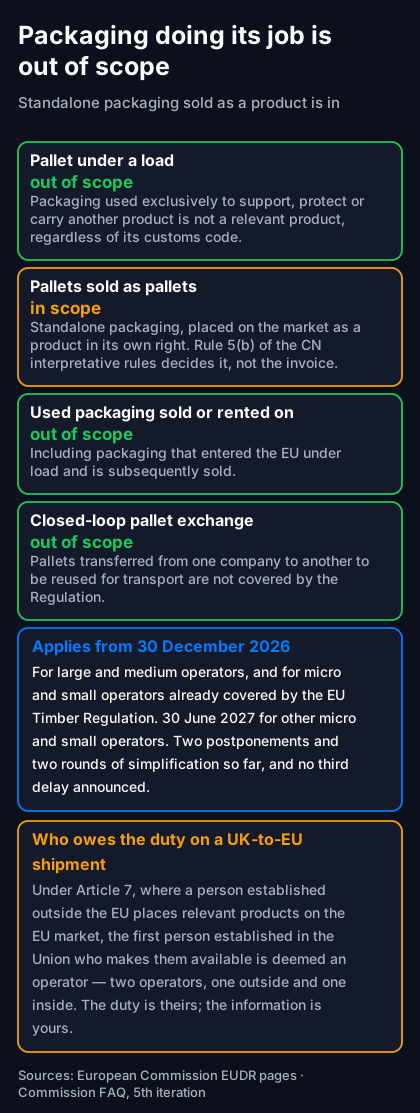
The EU Deforestation Regulation starts to apply on 30 December 2026 for large and medium operators. It covers seven commodities and a long list of products made from them, named by customs code, with no minimum quantity or value — and it asks for the geographic coordinates of the plot of land. This sets out what is in scope, who owes the duty on a UK-to-EU shipment, and why the pallets under the load are not part of it.
What is the EU Deforestation Regulation?
EUDR is the EU's regulation on deforestation-free products, Regulation (EU) 2023/1115. It bars seven commodities, and the products made from them, from the EU market unless the business placing them there can show the land they came from was not deforested after a cut-off date — and can point to the plot of land on a map.
It replaces the EU Timber Regulation, which covered wood alone and asked for a general duty of care. The new regime is broader in scope and far more specific in what it wants: coordinates, not assurances.
For a UK business the relevance is simple. Anything you send to the EU made from those seven commodities now has a documentary requirement attached that somebody in the chain has to satisfy, and that somebody will be asking you for the data.
When does it start to apply?
From the end of December 2026, in stages by the size of the business. The Commission's own topic page gives the dates after two postponements and two rounds of simplification, in amendments of December 2024 and December 2025.
| Who | Applies from |
|---|---|
| Large and medium operators | 30 December 2026 |
| Micro and small operators already covered by the EU Timber Regulation | 30 December 2026 |
| Other micro and small operators | 30 June 2027 |
| Products added by Commission Delegated Regulation (EU) 2026/2102 | 30 December 2027 |
The history of delays is worth knowing but not worth planning around. Both postponements arrived close to the deadline they moved, which is a poor basis for assuming a third, and the data the Regulation asks for — plot coordinates from a producer two or three steps up a supply chain — is not something a business can assemble in a fortnight.
Which commodities and products are covered?
Seven commodities: cattle, cocoa, coffee, oil palm, rubber, soya and wood. Then a much longer list of products derived from them, named by customs code in Annex I of the Regulation.
The derived-product list is where businesses find themselves unexpectedly in scope. Leather, chocolate, tyres and furniture are all on it, so a company that has never bought a commodity in its life can be handling relevant products all day — and the commodity code on the paperwork decides it rather than the description.
Commodities produced inside the EU are treated the same as imported ones. The Regulation is about the land, not the border.
Is there a minimum quantity or value?
No, and this is the answer that surprises people most. The Commission's FAQ is unambiguous: there is no threshold volume or value of a relevant commodity or relevant product, including within processed products, below which the Regulation would not apply.
So a sample box of coffee beans sent to a prospective EU buyer is in scope on the same terms as a container of them. Small consignments are the cases most likely to go wrong, because the paperwork habits that cover a container are rarely applied to a parcel.
This is the same structural trap as the low-value VAT rules in our IOSS article: the obligation does not scale down with the shipment, and the smaller the shipment, the likelier somebody assumes it does.
What is the cut-off date?
31 December 2020. Only products produced on land that has not been subject to deforestation or forest degradation after that date may be placed on the EU market or exported from it.
The date does two things at once. It fixes a factual question — what was growing on that plot at the end of 2020 — and it makes satellite imagery the evidence base, which is why the Regulation asks for coordinates rather than certificates.
It also means compliance is not something a supplier can improve. Either the land was cleared after the cut-off or it was not, and no amount of later good practice changes the answer for that plot.
What does due diligence actually require?
Three steps, set out in the Commission's due diligence guidance, and the first one carries the weight.
- Collect the information required by Article 9 — the commodity, quantity, supplier, country of production, evidence of legal harvest, and the geographic coordinates of the plots of land where the commodity was produced.
- Assess the risk against the Article 10 criteria, which include the prevalence of deforestation in the area, the complexity of the supply chain and the strength of law enforcement.
- Mitigate until the remaining risk is negligible — additional data, audits, or support for suppliers.
Where all the commodities come from countries classified as low risk, steps two and three can be skipped, provided there is no meaningful risk of circumvention. Step one cannot be skipped by anybody: the coordinates go into a due diligence statement submitted to the Information System before the goods are placed on the market or exported.
And the responsibility for those coordinates does not travel with them. The FAQ is explicit that an operator may use the producer's geolocation data, but it is the operator who is ultimately responsible for its accuracy, not the producer who provided it.
Who carries the duty on a UK-to-EU shipment?
Both ends, by design. Under Article 7, where a person established outside the EU places relevant products on the EU market, the first person established in the Union who makes those products available is deemed to be an operator — so, as the FAQ puts it, there will be two operators within the meaning of the Regulation, one established outside and one inside the EU.
The point of that deeming, recorded in the Regulation's own recitals, is that every EU supply chain contains an operator who is established in the Union and can be held accountable. Enforcement needs somebody reachable.
The practical consequence for a UK exporter is indirect but firm. There are no legal obligations applicable to non-EU countries — the FAQ says so plainly — and yet the EU-established operator cannot submit a statement without data only the UK side can supply. The duty is theirs; the information is yours; the order will not ship until the two meet. For the UK side that makes EUDR a data problem rather than a legal one. Our UK to EU shipping article covers the rest of that paperwork chain.
Are wooden pallets and packaging in scope?
Not when they are doing their job. The FAQ addresses this directly: packaging material used exclusively as packaging material to support, protect or carry another product placed on the EU market is not a relevant product within the meaning of Annex I, regardless of the customs code it falls under.
What flips a pallet into scope is being sold as a thing in itself. Packaging placed on the market or exported as a product in its own right — standalone packaging — is covered, and the test is not whether it appears on the invoice. The FAQ points instead to rule 5(b) of the general rules for interpreting the Combined Nomenclature: what matters is whether the packaging would be classified jointly with or separately from the goods.
| Situation | In scope? |
|---|---|
| Wooden pallet under a load of goods | No — packaging supporting another product |
| Pallets sold as pallets | Yes — standalone packaging |
| Used packaging sold or rented on to other companies | No |
| Packaging that entered the EU under load and is later sold | No |
| Pallets moving in a closed-loop exchange system | No |
That last row is the one worth filing. Pallets transferred from one company to another to be reused for transport — the arrangement our pallet exchange article describes, and the one standard pallet sizes exist to serve — sits outside the Regulation.
Does a haulier or freight forwarder have obligations?
Not as a carrier, and the Regulation's own role definitions are the reason. Its obligations attach to operators, downstream operators and traders — the people who place relevant products on the market, make them available, or export them. The Commission's due diligence guidance contains nothing about transport, carriage, hauliers, freight forwarders or logistics providers.
There is one role in the Regulation a service provider can take on, and it has to be given deliberately. An authorised representative under Article 6 submits a due diligence statement on behalf of an operator. The FAQ draws a firm line between that and the customs representative under Article 18 of the Union Customs Code, who lodges the customs declaration: the two roles are separate, and a company offering both services needs two explicit and different mandates with two separate sets of responsibilities.
So the fact that somebody handles your export declaration does not make them your authorised representative for EUDR, and should not be assumed to. See our note on the commercial invoice for the adjacent paperwork, and customs declaration for the document itself.
What happens if a product does not comply?
It cannot move, and the operator has to say so. Operators retain responsibility for the compliance of what they place on the market or export; where a product is non-compliant they must refrain from placing or exporting it, and immediately inform the competent authorities and any downstream operators and traders they have supplied.
Downstream operators and traders carry lighter but real duties — information obligations, and for larger businesses faced with substantiated concerns, verification. Nobody in the chain is a pure bystander.
The commercial effect is that non-compliance surfaces as a stopped shipment rather than a fine in the post. A load that cannot lawfully be placed on the market is a load nobody will take delivery of, whatever the contract says.
What should a UK shipper do now?
Work out whether anything you send into the EU appears in Annex I, and if it does, start the conversation with your EU customer about who is submitting the statement and what they will need from you. That conversation takes longer than the paperwork.
Then check upstream. If your own supplier cannot tell you which plot of land a commodity came from, neither can you, and the gap will not close faster for being discovered in December. Our proof of origin and customs value articles cover the two other data sets that the same shipment needs.
For our part: we are a carrier, not a customs or environmental agent. We do not submit due diligence statements, we are nobody's authorised representative under Article 6, and nothing we issue evidences a plot of land. What we do is move the goods once the people who owe those duties have discharged them — see international shipping for the work itself, and Incoterms for who is supposed to be arranging what.
Questions
- What is the EU Deforestation Regulation?
- Regulation (EU) 2023/1115 on deforestation-free products. It bars seven commodities, and products derived from them, from the EU market unless the business placing them there can show the land was not deforested after 31 December 2020 — and can give the geographic coordinates of the plot. It replaces the EU Timber Regulation, which covered wood alone and asked for a general duty of care rather than coordinates.
- When does EUDR start to apply?
- 30 December 2026 for large and medium operators, and for micro and small operators already covered by the EU Timber Regulation. 30 June 2027 for other micro and small operators. Products added by Commission Delegated Regulation (EU) 2026/2102 apply from 30 December 2027. Those dates follow two postponements and two rounds of simplification, amended in December 2024 and December 2025.
- Which commodities does EUDR cover?
- Cattle, cocoa, coffee, oil palm, rubber, soya and wood, plus a long list of derived products named by customs code in Annex I — leather, chocolate, tyres and furniture among them. The derived-product list is where businesses find themselves unexpectedly in scope, and the commodity code on the paperwork decides it rather than the description. Commodities produced inside the EU are treated the same as imported ones.
- Is there a minimum quantity or value below which EUDR does not apply?
- No. The Commission's FAQ states there is no threshold volume or value of a relevant commodity or relevant product, including within processed products, below which the Regulation would not apply. A sample box of coffee beans sent to a prospective EU buyer is in scope on the same terms as a container of them — and small consignments are the likeliest to be missed, because parcel paperwork habits differ from container ones.
- Are wooden pallets covered by EUDR?
- Not while they are carrying goods. Packaging used exclusively as packaging material to support, protect or carry another product placed on the EU market is not a relevant product within the meaning of Annex I, regardless of its customs code. Packaging sold as a product in its own right is covered. Selling or renting used packaging on, and closed-loop pallet exchange where pallets are transferred between companies to be reused, are outside the Regulation.
- Who is responsible for EUDR on a shipment from the UK into the EU?
- Both ends. Under Article 7, where a person established outside the EU places relevant products on the EU market, the first person established in the Union who makes them available is deemed to be an operator — so there are two operators, one outside and one inside the EU. There are no legal obligations on non-EU countries, but the EU operator cannot submit a statement without data only the UK side holds.
- Does a haulier need to do anything under EUDR?
- Not as a carrier. The obligations attach to operators, downstream operators and traders — those who place relevant products on the market, make them available or export them — and the Commission's due diligence guidance says nothing about transport, carriage, hauliers or freight forwarders. A service provider can be appointed an authorised representative under Article 6 to submit the statement, but that is a separate mandate from being a customs representative.
Explore more
More from the blog
- Sending Goods Abroad for Repair, and Bringing Them…
- Packing groups: what I, II and III actually change
- Who owns the pallet: exchange, pooled and one-way c…
- Pallet Sizes and How Many Fit in Each Vehicle: UK G…
- Product recall logistics: the collection is easy, t…
- Proof of Origin: The Four Ways to Prove Where Goods…