
Customs value: what has to go in, and who answers for it
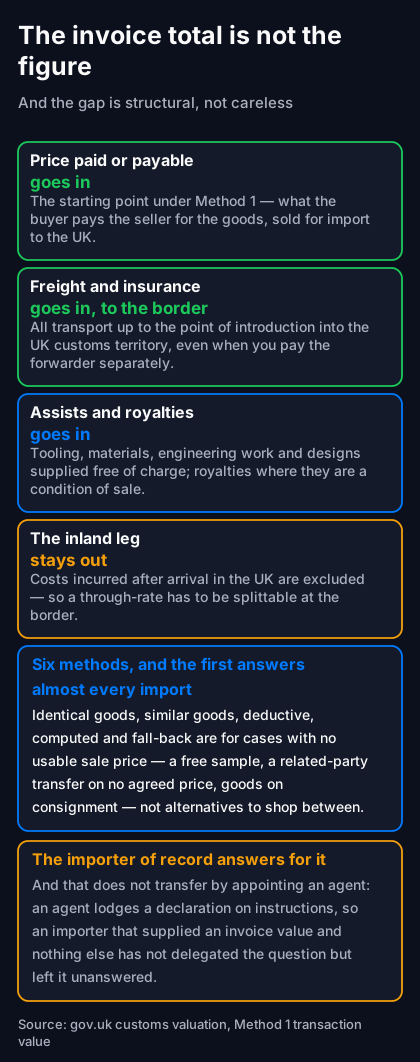
The customs value is the figure duty and import VAT are calculated on, and it is not the invoice total. Method 1 starts from the price paid or payable for the goods, then adds freight and insurance up to the point of introduction into the UK, assists supplied free of charge, and royalties that are a condition of sale — while costs after arrival are excluded. This sets out what goes in, what stays out, and who answers for the figure.
What is the customs value?
The customs value is the figure duty and import VAT are calculated on, and it is not the same as the invoice total. It starts from what was paid for the goods and then has costs added to it that the invoice may never mention.
That gap is where most valuation errors live. An importer who declares the invoice value and stops has under-declared whenever freight was billed separately, which is most of the time — and the error is structural rather than careless, because nothing on the invoice says anything is missing.
Getting it wrong is expensive in both directions. Under-declaring creates a duty liability that surfaces at audit with interest attached; over-declaring means paying duty on money that was never part of the goods' price, and nobody refunds that unprompted.
It is also the figure that compounds. Duty is a percentage of it, import VAT is charged on the duty-inclusive amount, and both are repeated on every consignment under the same arrangement — so a structural error in how the value is built is not one mistake but one mistake multiplied by the number of shipments before anybody looks.
Which method applies?
There are six, and the first one answers almost every import. Gov.uk calls it Method 1, the transaction value: the price paid or payable by the buyer to the seller for the goods when sold for import to the UK.
| Method | Basis |
|---|---|
| 1 — Transaction value | The price paid or payable for these goods |
| 2 — Identical goods | The transaction value of identical goods |
| 3 — Similar goods | The transaction value of similar goods |
| 4 — Deductive | Worked back from the resale price in the UK |
| 5 — Computed | Built up from cost of production plus profit |
| 6 — Fall-back | Reasonable means consistent with the principles |
The guidance tells an importer to concentrate on whether an acceptable transaction value exists before examining the other methods, which is the practical instruction: methods 2 to 6 are for the cases where there is no usable sale price, not alternatives to be shopped between. A free-of-charge sample, a transfer between related parties on no agreed price, or goods on consignment are the situations that push you down the list.
What has to be added to the price?
Five categories, and transport is the one that catches ordinary importers. Gov.uk requires all transport costs up to the place of introduction into the customs territory of the UK to be included.
- Freight and handling, up to the point of introduction into the UK customs territory.
- Insurance covering the transport and handling before arrival.
- Assists — equipment, materials, engineering work and designs supplied by the importer.
- Royalties and licence fees, where they relate to the goods and are a condition of sale.
- Selling commissions and brokerage, but not buying commissions.
Read the first line again: those costs go in even where the importer pays them separately to a freight forwarder rather than to the seller. A consignment bought ex works and shipped on the importer's own account therefore has a customs value above its invoice value by the whole cost of getting it to the frontier.
Where does the transport cost stop counting?
At the border, and the line is drawn by place rather than by invoice. Costs incurred after arrival in the UK are excluded from the valuation, so the inland leg from the port to the warehouse is outside the figure.
That makes the apportionment question real on a single through-rate. A forwarder quoting one price from a factory in Asia to a door in the Midlands has quoted a figure that straddles the boundary, and the customs value needs the part up to the point of introduction, not the lot.
Our Incoterms article matters here more than it looks: the delivery term decides who is buying the freight and therefore where it appears, but it does not change where the valuation boundary sits. The boundary is geographic and the term is commercial.
Why do assists catch people out?
Because nothing is paid for them, so nothing shows up in the ledger. An assist is something the importer supplies to the seller free of charge or at reduced cost that goes into making the goods — tooling, materials, components, engineering work, designs.
The classic case is a mould. A UK buyer pays a toolmaker for an injection mould, ships it to a manufacturer abroad, and buys finished parts at a unit price that reflects the buyer already owning the tooling. The unit price is genuine, the invoice is genuine, and the customs value is understated by the value of the mould until it is apportioned across the parts it makes.
Royalties work the same way when they are a condition of sale. A licence fee paid to a third party rather than to the seller still forms part of the customs value where the goods could not have been bought without it, which is a question about the contracts rather than about the money's destination.
Who declares the value, and who answers for it?
The importer of record, and the phrase is doing legal work rather than describing a role in a process. The importer of record is the party in whose name the goods are declared, and it carries the responsibility for the declaration being correct — including the value.
That responsibility does not transfer by using an agent. A customs agent lodges a declaration on instructions; an importer who gave the agent an invoice value and nothing else has not delegated the valuation question, it has simply not answered it. Our customs page sets out where coordination with a broker starts and stops.
It is also not automatically the buyer. On delivered-duty-paid terms the seller may be acting as importer, which puts the valuation duty on a party in another country — and makes who holds the records a question worth settling before the first shipment rather than at the first audit.
What records have to exist?
Enough to rebuild the figure from its parts, years later, without the people who built it.
| Element | What evidences it |
|---|---|
| Price paid or payable | Commercial invoice and the contract or order |
| Freight to the border | Carrier invoices, with the inland leg separable |
| Insurance | Policy or certificate covering the pre-arrival leg |
| Assists | Tooling invoices and the apportionment calculation |
| Royalties | The licence agreement showing whether it is a condition of sale |
The fourth row is the one that is usually missing. An apportionment calculation is a working document rather than an invoice, so it exists in somebody's spreadsheet until that person leaves — and a valuation that cannot be reconstructed is a valuation that will be substituted by somebody else's.
How does valuation interact with duty relief?
It sets the base that every relief is measured against, which makes it the first number rather than a detail. A tariff preference reduces the rate applied to the customs value; it does not change the value.
So the sequence runs: establish the value, classify the goods, then see what relief applies. Our commodity code article covers the classification step and proof of origin the relief that most often follows — and a mis-stated value quietly scales the error through both.
Where goods are not being imported at all, the question falls away. Goods under transit have not been imported, and goods in a customs warehouse have the liability suspended — see customs special procedures and where goods wait before clearance.
What should you check before the first shipment?
Five questions, and four of them are about contracts rather than goods.
- Who is the importer of record, and has that party agreed to it in writing?
- What delivery term applies, and therefore who buys the freight?
- Can the freight be split at the point of introduction into the UK?
- Are there assists — tooling, materials, designs supplied free of charge?
- Are there royalties that are a condition of sale?
Answer those and the valuation is arithmetic. Leave them and the first audit becomes a reconstruction exercise, carried out by somebody with no commercial memory of the arrangement and no obligation to assume the generous reading. The UK Trade Tariff service sets out the valuation rules alongside the classification tools.
What is our part in this?
We carry the goods and we do not value them. We are not a customs agent, we do not lodge declarations, and no instruction from us should ever be the source of a customs value.
Where we are relevant is the second row of that records table. A carrier's invoice is the evidence of the freight element, and a through-rate that cannot be split at the border leaves an importer unable to evidence the figure it declared — so a rate stated in a way that separates the pre-arrival leg from the inland one is worth asking for, from us or from anybody.
For the figures a carrier does determine, see chargeable weight; for the documents that travel with the value, commercial invoices and safety and security declarations.
Questions
- What is the customs value of imported goods?
- The figure duty and import VAT are calculated on, which is not the same as the invoice total. Under Method 1 it is the price paid or payable by the buyer to the seller for the goods when sold for import to the UK, with specified costs added — freight and insurance to the border, assists, and royalties that are a condition of sale. An importer who declares the invoice value alone has usually under-declared.
- How many customs valuation methods are there?
- Six. Method 1 is the transaction value of the goods themselves; methods 2 and 3 use the transaction value of identical or similar goods; method 4 works back from the UK resale price; method 5 builds up from cost of production; method 6 is a fall-back using reasonable means. Gov.uk directs importers to concentrate on whether an acceptable transaction value exists before examining the others — they are for cases with no usable sale price, not alternatives to choose between.
- Does freight go into the customs value?
- Yes, up to the place of introduction into the customs territory of the UK, together with insurance covering the pre-arrival transport — and it goes in even where the importer pays the forwarder separately rather than paying the seller. Costs incurred after arrival in the UK are excluded, so the inland leg from port to warehouse is outside the figure. A single through-rate therefore has to be capable of being split at the border.
- What is an assist in customs valuation?
- Something the importer supplies to the seller free of charge or below cost that goes into making the goods — tooling, materials, components, engineering work or designs. The classic case is a mould: the buyer pays a toolmaker, ships the mould abroad, and buys parts at a unit price reflecting that the buyer already owns the tooling. Invoice and price are both genuine, and the customs value is understated until the mould is apportioned across the parts.
- Are royalties part of the customs value?
- Where they relate to the goods and are a condition of sale, yes — including when they are paid to a third party rather than to the seller. The test is whether the goods could have been bought without the payment, which makes it a question about the contracts rather than about where the money goes. Selling commissions and brokerage are also added, but buying commissions are not.
- Who is responsible for the customs value being correct?
- The importer of record — the party in whose name the goods are declared. That responsibility does not transfer by appointing an agent: an agent lodges a declaration on instructions, so an importer that supplied an invoice value and nothing else has not delegated the valuation question but simply left it unanswered. It is also not automatically the buyer; on delivered-duty-paid terms the seller may be acting as importer.
- Does a tariff preference change the customs value?
- No. A preference reduces the rate of duty applied to the customs value; it does not alter the value itself. The sequence is to establish the value, classify the goods, then apply whatever relief is available — which is why a mis-stated value quietly scales the error through both the classification and the relief. Goods under transit or in a customs warehouse have not reached that point at all.
Explore more
More from the blog
- UK Pharmaceutical Transport: GDP Compliance Guide […
- Aerospace AOG Support: Emergency Parts Delivery Acr…
- Aerospace Courier UK — AOG & Parts Logistics Guide…
- UK Pharmaceutical Cold Chain Logistics: 2026 Compli…
- Heathrow Cargo: The Complete Guide for Freight Ship…
- Van Size Guide: Which Courier Vehicle Do You Need?