
EPR for packaging: who is obligated, what they report, and why pallets are in it
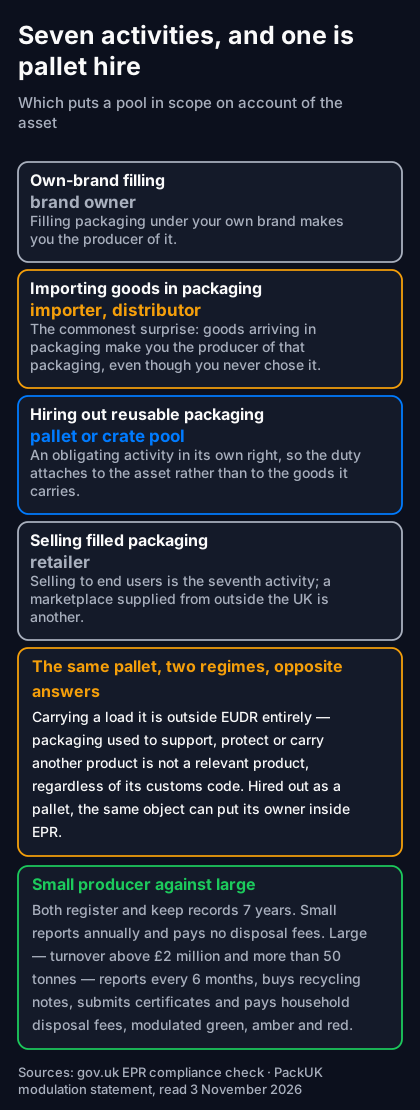
Extended producer responsibility makes the business that puts packaging on the UK market pay for dealing with it afterwards. Obligation starts at £1 million turnover combined with more than 25 tonnes of packaging, and one of the seven obligating activities is hiring out reusable packaging — which puts pallet pools in scope on account of the asset rather than the goods. This sets out who is obligated, what small and large producers each owe, and how the fees are modulated.
What is extended producer responsibility for packaging?
EPR is the rule that makes the business which puts packaging on the UK market pay for dealing with it afterwards. It replaced a system where households and councils carried most of that cost, and it works by obliging producers to report what they supply and, above a size, to pay a fee per tonne of it.
The shift is in who the bill lands on rather than in what happens to the packaging. The same cardboard still goes in the same collection; the difference is that the business whose brand was on it now funds the collection.
That makes it a reporting obligation before it is a cost. A producer that cannot say how much packaging it supplied, by material, cannot comply at any price — which is why the data is the hard part.
Which activities make you obligated?
Seven, and the list is about what you do with packaging rather than what you sell. Gov.uk's compliance check sets them out.
| Activity | Typical business |
|---|---|
| Filling packaging under your own brand | Brand owner |
| Packing goods or filling packaging | Co-packer, contract filler |
| Importing goods in packaging | Importer, distributor |
| Supplying unfilled packaging you make or import | Packaging manufacturer |
| Hiring or loaning out reusable packaging | Pallet or crate pool |
| Owning an online marketplace supplied from outside the UK | Marketplace operator |
| Selling filled packaging to end users | Retailer |
Read the third row twice if you import. Bringing in goods that arrive in packaging makes you the producer of that packaging, even though you never chose it, never ordered it and may not want it — which is the single commonest surprise in the regime.
Does hiring out reusable packaging count?
Yes, and that is the row most logistics businesses miss. Hiring or loaning out reusable packaging is an obligating activity in its own right, which puts pallet and crate pools inside the regime on account of the asset rather than the goods.
Set that against the answer our EUDR article found for the same object, and the contrast is instructive. A wooden pallet carrying a load is outside the EU Deforestation Regulation entirely, because packaging used to support, protect or carry another product is not a relevant product — yet the same pallet, hired out as a pallet, can put its owner inside EPR.
So the question "is this pallet regulated?" has no answer until you say which regime and in what role. Our pallet exchange article covers who owns it; this one covers who reports it, and the two are different parties more often than not.
Where are the thresholds?
Below a floor you are outside the regime entirely. Obligation starts at £1 million of annual turnover combined with more than 25 tonnes of packaging supplied or imported in a year — both tests, not either.
At the top end, a large producer is an organisation with turnover above £2 million and more than 50 tonnes of packaging. Between the floor and that test sits the small producer band, with a lighter set of duties described below.
The combined test is what catches people out in both directions. A high-turnover business shipping very little packaging can be outside the regime, and a modest business shipping a lot of it can be inside — so neither figure answers the question on its own.
Establishing which side of the tonnage test you fall on is itself work. Few businesses know the weight of their packaging by material, because nobody had a reason to record it: the figure has to come from supplier specifications or from weighing a representative pack and multiplying, and the two methods rarely agree closely. A business near the floor therefore needs the measurement before it can know whether it needs the registration, which is the wrong way round but unavoidable.
What does a small producer have to do?
Register, report once a year, and keep the evidence. Small producers register with the environmental regulator, report their packaging data annually, and keep records for 7 years.
- Register with the environmental regulator for your nation.
- Report packaging data annually, by material and weight.
- Keep records for 7 years, which is longer than most businesses keep delivery paperwork.
The record-keeping period is the part that bites later. Seven years of material-by-material packaging weights is not something a business can reconstruct after the fact, and the obligation lands on whoever has to answer for the data rather than on whoever ordered the boxes.
What does a large producer have to do on top?
Report twice as often and pay. On top of registration and reporting, large producers report packaging data every 6 months, obtain packaging waste recycling notes or export equivalents, submit compliance certificates, and pay household packaging disposal fees.
| Duty | Small producer | Large producer |
|---|---|---|
| Register with the regulator | Yes | Yes |
| Report packaging data | Annually | Every 6 months |
| Recycling notes (PRNs / PERNs) | No | Yes |
| Compliance certificates | No | Yes |
| Household packaging disposal fees | No | Yes |
| Keep records | 7 years | 7 years |
The gap between the two columns is wide enough that crossing the large-producer test is a budget event rather than an administrative one, and it is reached by growing either turnover or packaging weight.
Can a brand owner escape by letting someone else import?
No. The brand owner remains obligated even where another organisation imports or packs the branded goods, so the duty follows the brand rather than the paperwork.
That is deliberate, and it closes the obvious route round the regime. If obligation followed whoever physically imported, every brand would import through a thin third party and the reporting would evaporate.
In practice it means a supply contract has to say who reports what. Two businesses can both be in scope for the same consignment in different roles, and a contract silent on EPR leaves both assuming the other one filed.
How do the disposal fees work?
By material, and modulated by how recyclable that material is. PackUK's modulation statement sets fees against a green, amber and red rating, so two packs of the same weight can cost different amounts depending on what they are made of.
The modulation sharpens over time rather than staying flat. Red fees sit at 1.2 times the amber rate in year 2, rising toward 2 times by year 4 — a schedule designed to make the cost of a hard-to-recycle pack grow faster than the cost of an easy one.
We have deliberately not reproduced the per-tonne figures here. They are published as illustrative, reset annually, and a table of last year's rates copied into an article is the most reliable way to be confidently wrong — read them from the live source.
What about the plastic packaging tax?
It is a separate charge with its own test, and paying one does not discharge the other. Plastic packaging tax applies to plastic packaging components manufactured in or imported into the UK that contain less than 30% recycled plastic, above an annual weight threshold.
So a business can be registered for both, for one, or for neither, and the two regimes measure different things: EPR counts all packaging by material, while the tax counts plastic components by recycled content. The same pack can be reportable under EPR and untaxed, or taxed and below the EPR floor.
Treating them as one obligation is the error worth avoiding. They have different thresholds, different returns and different regulators.
What does this mean for how goods are packed?
Lighter and more recyclable both now have a price, which they did not before. When a fee is charged per tonne by material, over-packing has a measurable annual cost rather than an aesthetic one, and the cheapest reduction is usually the void fill nobody chose deliberately.
It also changes the arithmetic on reusable packaging — in both directions. A crate that makes twenty trips keeps nineteen single-use packs out of the report, but hiring crates out is itself an obligating activity, so the saving lands with the user and the duty with the owner.
And the pack still has to survive the journey. Our groupage article makes the point that consolidated freight is handled four or five times rather than twice, so packaging reduced past the point of protection converts a reporting saving into a damage claim. ISPM 15 covers the separate treatment rules for wood.
Where do we stand in this?
EPR falls on whoever places packaging on the market, and carrying goods is not placing packaging on the market. We are not the obligated producer for our customers' packaging, we are not a compliance scheme, and we do not report packaging data on anybody's behalf.
What we can do is not make your numbers worse. Pallet and load configuration decides how much packaging a consignment needs, and a consignment planned for the vehicle needs less of it — see pallet sizes and vehicle capacity and pallet delivery.
For the waste side of the same subject, our digital waste tracking article covers the movement records and waste duty of care the duty that governs them. Those are the parts where we are a party; EPR is not one of them.
Questions
- What is extended producer responsibility for packaging?
- The rule that makes the business putting packaging on the UK market pay for dealing with it afterwards, replacing a system where households and councils carried most of that cost. Producers report what they supply by material and weight, and above a size pay a fee per tonne. The shift is in who the bill lands on rather than in what happens to the packaging — but it is a reporting obligation before it is a cost.
- Which activities make a business obligated under EPR?
- Seven: filling packaging under your own brand; packing goods or filling packaging; importing goods in packaging; supplying unfilled packaging you make or import; hiring or loaning out reusable packaging; owning an online marketplace supplied from outside the UK; and selling filled packaging to end users. Importing is the commonest surprise — goods arriving in packaging make you the producer of that packaging even though you never chose it.
- Does hiring out pallets or crates count as an EPR activity?
- Yes. Hiring or loaning out reusable packaging is an obligating activity in its own right, which puts pallet and crate pools inside the regime on account of the asset rather than the goods. The contrast with EUDR is instructive: a wooden pallet carrying a load is outside the EU Deforestation Regulation entirely, yet the same pallet hired out as a pallet can put its owner inside EPR.
- What are the EPR thresholds?
- Obligation starts at £1 million of annual turnover combined with more than 25 tonnes of packaging supplied or imported in a year — both tests, not either. A large producer has turnover above £2 million and more than 50 tonnes of packaging; the band between is the small producer category. The combined test catches people out both ways, so neither figure answers the question on its own.
- What is the difference between a small and a large producer?
- Both register and keep records for 7 years. A small producer reports packaging data annually and pays no disposal fees. A large producer reports every 6 months, obtains packaging waste recycling notes or export equivalents, submits compliance certificates and pays household packaging disposal fees. The gap is wide enough that crossing the large-producer test is a budget event rather than an administrative one.
- Can a brand owner avoid EPR by letting someone else import the goods?
- No. The brand owner remains obligated even where another organisation imports or packs the branded goods, so the duty follows the brand rather than the paperwork. That closes the obvious route round the regime. In practice two businesses can be in scope for the same consignment in different roles, so a supply contract silent on EPR leaves both assuming the other one filed.
- Is the plastic packaging tax the same thing as EPR?
- No, and paying one does not discharge the other. Plastic packaging tax applies to plastic packaging components manufactured in or imported into the UK containing less than 30% recycled plastic, above an annual weight threshold. EPR counts all packaging by material; the tax counts plastic components by recycled content. The same pack can be reportable under EPR and untaxed, or taxed and below the EPR floor.