
Waste carrier registration: who needs one, and what it does not permit
A waste carrier registration is the Environment Agency's authorisation to move, broker or deal in waste in England, and the number resolves to a public record showing the tier, the roles and the expiry date. Upper tier is renewed every three years; lower tier never. The penalty for operating without one is an unlimited fine, and the producer who hands waste over carries its own duty to check. This sets out who needs one, what it does not permit, and how to evidence the check.
What is a waste carrier registration?
A waste carrier registration is the Environment Agency's authorisation to move, broker or deal in waste in England. It is a registration rather than a permit: it says who you are and what role you hold, and it is the thing a customer checks before handing waste over.
The number is the point of it. A registration resolves to a public record showing the tier, the roles held and the expiry date, so a claim to be registered is checkable by a stranger in under a minute — which is exactly what the waste duty of care expects a producer to do.
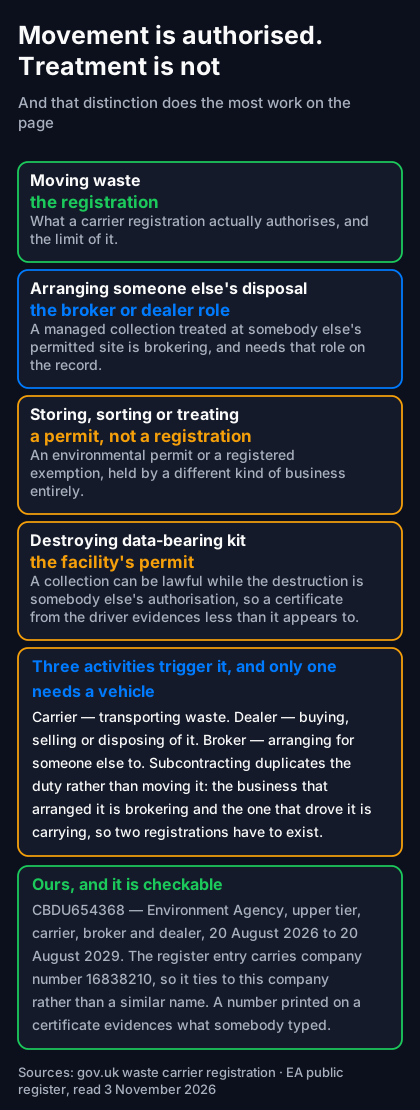
It is not a licence to do anything with the waste beyond move or arrange it, and that distinction does more work than anything else on this page.
Who needs one?
Three activities trigger it, and only one of them involves a vehicle. Gov.uk requires registration from a business that transports waste, that buys, sells or disposes of waste, or that arranges for someone else to buy, sell or dispose of it.
| Role | What it covers | Vehicle needed? |
|---|---|---|
| Carrier | Transporting waste | Yes |
| Dealer | Buying, selling or disposing of waste | No |
| Broker | Arranging for someone else to do it | No |
The broker role is the one businesses fall into without noticing. An office-clearance firm that subcontracts the disposal, or a facilities manager who arranges collections on a client's behalf, is arranging for someone else to dispose of waste — which is a registrable activity whether or not anything is ever loaded.
Subcontracting does not move the problem either, it duplicates it. Where one business arranges a collection and another drives it, both activities are registrable: the one that arranged it is brokering and the one that carried it is carrying, so two registrations have to exist rather than one. A producer checking only the name on the invoice has checked the broker and not the carrier, and it is the carrier who physically takes the waste away.
Is it free if you only move your own waste?
Usually, yes — registration is normally free where you only transport waste you produce yourself. A business taking its own offcuts to a tip is in a different position from one collecting other people's.
The exemption is about whose waste it is rather than how much of it there is. The moment a vehicle carries waste that belongs to somebody else, the activity is commercial waste carriage and the free route closes.
Construction and demolition waste is the standing exception to watch, because it has its own treatment under the rules even when it is the carrier's own. If in doubt the register application asks the question directly, and answering it accurately is cheaper than discovering the answer later.
What does the register actually tell you?
Four things, and together they answer whether a carrier may lawfully take your waste today. The record shows the registration number, the tier, the roles held, and the expiry date.
Tier reflects what the business does rather than how big it is — our waste duty of care entry sets out the upper and lower tier test in full, and that is the place to read it rather than here.
The roles field is the one most buyers skim. A business registered as a carrier only is not authorised to broker, so a "managed collection" where somebody else's permitted site does the treatment needs the broker role on the record as well as the carrier one.
How long does a registration last?
Upper tier registrations are renewed every 3 years. Lower tier registrations do not need renewing at all, which is a real asymmetry rather than a technicality.
- Upper tier — a fee set by the Environment Agency, renewed on a 3 year cycle, with an expiry date on the public record.
- Lower tier — no renewal, so the record stays valid until the business changes what it does.
- Either — details have to be kept current, because the register is what third parties rely on.
Our own registration shows the pattern: CBDU654368 runs from 20 August 2026 to 20 August 2029, which is the three-year term on the face of the record.
What happens if it lapses mid-contract?
The carriage stops being lawful on the expiry date, and the producer's position goes with it. A waste transfer during a lapsed registration is a transfer to an unregistered carrier however long the relationship has run, because the duty of care attaches to each transfer rather than to the contract.
This is the practical reason a one-off check at account opening is not enough. A supplier verified two years ago may be weeks from expiry, and nothing in the commercial relationship will announce it.
The cheap control is a diary date rather than a policy. Record the expiry when you first check the register, and re-check before it — the same discipline our waste transfer note article asks for on the documents themselves.
What does the registration not permit?
Anything done to the waste rather than with it. A carrier registration authorises movement; treating, storing, sorting or disposing of waste needs an environmental permit or a registered exemption, which is a different authorisation held by a different kind of business.
| Activity | Authorised by |
|---|---|
| Moving waste | Waste carrier registration |
| Arranging someone else's disposal | Broker or dealer role on the registration |
| Storing, sorting or treating waste | Environmental permit or registered exemption |
| Accepting waste at a site | The site's own permit |
| Destroying data-bearing equipment | The treatment facility's permit, not the carrier's |
The last row is where IT disposal goes wrong in practice. A collection can be entirely lawful and the destruction still be somebody else's authorisation, so a certificate issued by whoever drove the van evidences less than it appears to — see chain of custody for what the paper trail should actually consist of.
What is the penalty for not having one?
An unlimited fine. Gov.uk puts it plainly: you can get an unlimited fine if you do not register, and there is no small-operator carve-out from that.
The exposure is not confined to the carrier either. A producer who hands waste to an unregistered carrier has breached its own duty of care, which is why the check sits with the person giving the waste away rather than with the regulator.
And the paperwork tends to find its way back. Fly-tipped waste is routinely traced through whatever documents it contains, at which point a dated register check is the difference between a producer who discharged its duty and one who did not.
How should a buyer evidence the check?
With a dated record, not a recollection. The duty of care expects records of the checks you made, and a check that happened but was not written down is indistinguishable afterwards from one that never happened.
- Look the number up on the public register rather than trusting a certificate or a laminated card.
- Record the number, the tier, the roles and the expiry, with the date you looked.
- Diarise the expiry, because the record you keep is only as current as the day you made it.
- Keep it with the transfer documents, so the job and the check can be produced together.
Step one is the one worth insisting on. A number printed on a document evidences what somebody typed; only the register evidences a registration — the same structural point our AWRS article makes about alcohol wholesalers.
Which registration do we hold?
An upper tier registration as carrier, broker and dealer: CBDU654368, issued by the Environment Agency, valid from 20 August 2026 to 20 August 2029. The register's own record carries company number 16838210, so it ties to this company rather than to a similarly named one.
We publish the number because a claim nobody can check is worth nothing. Our licences page lists every credential with its number and the register that proves it, alongside the accreditations we do not hold.
What that registration lets us do is collect and move waste, including on the WEEE collection and IT equipment collection work. What it does not do is authorise treatment or disposal: that happens at a permitted facility under the facility's permit, and we are the movement in between.
What does this registration not cover?
It is an England registration, and it is not an operator's licence. Scotland, Wales and Northern Ireland run their own carrier registration systems through their own regulators, so a cross-border waste movement engages more than one register — the pattern our digital waste tracking article describes for the nations' separate timetables.
Nor does it say anything about the vehicle or the driver. Goods vehicle operator licensing, drivers' hours and dangerous goods rules are separate regimes with separate authorisations: for loads that are both waste and dangerous goods, the hazardous waste consignment note and the ADR requirements both apply on top.
And it is not advice on classification. What the waste is, and which code describes it, is the producer's determination; we move what has been described to us and ask for the description to be accurate, because a wrong code on a transfer note is a defect nobody downstream can repair.
Questions
- What is a waste carrier registration?
- The Environment Agency's authorisation to move, broker or deal in waste in England. It is a registration rather than a permit: the number resolves to a public record showing the tier, the roles held and the expiry date, so a claim to be registered is checkable by a stranger in under a minute. What it does not do is authorise anything being done to the waste beyond moving or arranging it.
- Who needs a waste carrier registration?
- Any business that transports waste, that buys, sells or disposes of waste, or that arranges for someone else to do so — carrier, dealer and broker respectively. Only the first involves a vehicle. The broker role catches people out: an office-clearance firm that subcontracts disposal, or a facilities manager arranging collections for a client, is arranging someone else's disposal, which is registrable whether or not anything is loaded.
- Do I need to register if I only move my own waste?
- Registration is normally free where you only transport waste you produce yourself, so a business taking its own offcuts to a tip is in a different position from one collecting other people's. The exemption turns on whose waste it is rather than how much there is — the moment a vehicle carries waste belonging to somebody else, the free route closes. Construction and demolition waste has its own treatment.
- How long does a waste carrier registration last?
- Upper tier registrations are renewed every 3 years and carry an expiry date on the public record. Lower tier registrations do not need renewing at all. Details must be kept current either way, because the register is what third parties rely on. Our own entry shows the pattern: CBDU654368 runs from 20 August 2026 to 20 August 2029.
- What happens if a carrier's registration lapses during a contract?
- The carriage stops being lawful on the expiry date, and the producer's position goes with it: a transfer during a lapsed registration is a transfer to an unregistered carrier however long the relationship has run, because the duty of care attaches to each transfer rather than to the contract. A supplier verified two years ago may be weeks from expiry, and nothing commercial will announce it.
- What does a waste carrier registration not allow?
- Anything done to the waste rather than with it. Storing, sorting, treating or disposing of waste needs an environmental permit or a registered exemption, held by a different kind of business; accepting waste at a site is authorised by that site's permit. In IT disposal this matters: a collection can be lawful while the destruction is somebody else's authorisation entirely.
- What is the penalty for carrying waste without registration?
- An unlimited fine, with no small-operator carve-out. The exposure is not confined to the carrier: a producer who hands waste to an unregistered carrier has breached its own duty of care, which is why the check sits with the person giving the waste away. Fly-tipped waste is routinely traced through whatever documents it contains, and a dated register check is what separates the two positions.
Explore more
More from the blog
- Cabotage after Brexit: two jobs in, one job out
- Chargeable weight: why a light pallet can cost like…
- Clinical trial logistics: who owns the obligation,…
- The CMR note: what it covers, and what it actually…
- The commercial invoice: what your customs declarati…
- Sending Large and Heavy Items by Courier: When a Pa…