
Simpler Recycling: what a workplace must separate, and whose duty it is
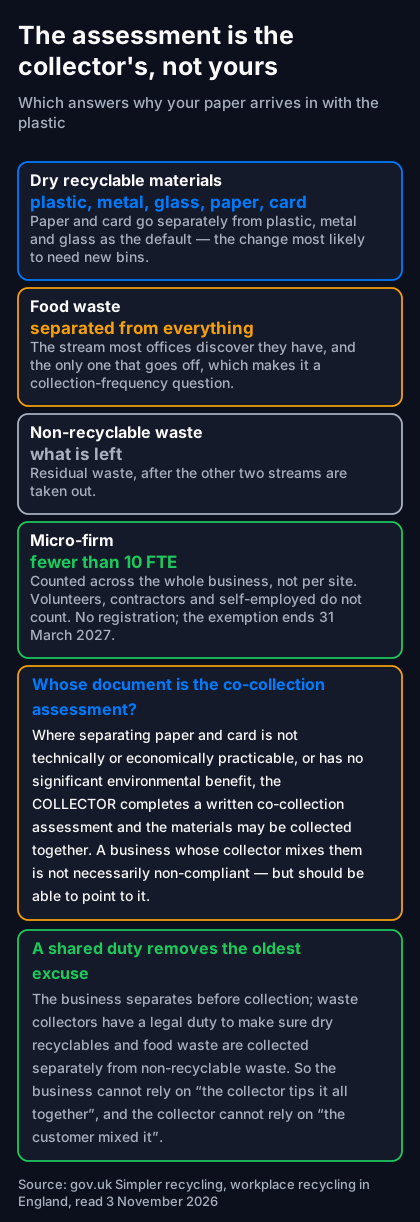
Workplace recycling in England became a legal requirement on 31 March 2025: every workplace must separate dry recyclables, food waste and residual waste before collection, including waste from employees, customers and visitors. Micro-firms have until 31 March 2027. Paper and card go separately from plastic, metal and glass unless the collector holds a written co-collection assessment — a document that belongs to the collector, not to you.
What changed on 31 March 2025?
Workplace recycling in England became a legal requirement rather than a local arrangement. From that date all workplaces in England must separate their waste before it is collected, including any waste produced by employees, customers and visitors.
The change is in the obligation rather than in the bins. Many businesses already separated recyclables because their collector asked them to; what is new is that the separation is required of the business itself, and is enforceable.
It sits alongside rather than inside the waste duty of care. Duty of care governs who may take your waste and what document records the transfer; Simpler Recycling governs what has to be separated before that transfer happens.
Which streams must be separated?
Three, and the first one is a group rather than a single material. Gov.uk requires every workplace to separate dry recyclable materials, food waste, and non-recyclable waste.
| Stream | What goes in it |
|---|---|
| Dry recyclable materials | Plastic, metal, glass, paper and card |
| Food waste | Food waste, separated from everything else |
| Non-recyclable waste | Residual waste, what is left |
Food waste is the stream most offices discover they have. A kitchen with a microwave and twelve desks generates it daily, and before these rules it went into general waste without anyone deciding that it should.
It is also the stream with the most operational consequences, because it is the only one that goes off. A dry recyclables bin can be emptied weekly without anyone minding; a food waste bin on the same frequency is a different proposition in a warm office, which is why the separation question quickly becomes a collection frequency question. Caddies at the point of use and a single lockable container outside is the arrangement most businesses land on, and it is cheaper to set up at the start than to retrofit once the bin store is already full.
Does paper have to be separate from plastic?
As a default, yes. Paper and card must generally be kept separate from plastic, metal and glass rather than going into one mixed recycling bin.
That surprises businesses that have had a single commingled recycling container for years, and it is the practical change most likely to need new bins. The default is paper and card in one stream, and plastic, metal and glass in another.
There is a route to collecting them together, but it is not the business's decision to make — which is the subject of the next section, and the most misunderstood part of the whole scheme.
What is a co-collection assessment, and whose is it?
It is the collector's document. Where separating paper and card is not technically or economically practicable, or has no significant environmental benefit, the waste collector can complete a written co-collection assessment, and the materials may then be collected together.
So a business whose collector takes paper in with the plastic is not necessarily non-compliant — but it should be able to point to the assessment that permits it. Asking for it is a reasonable question to put to a collector, and the absence of an answer is informative.
The direction of the duty is the thing to carry away. The business separates what it is told to separate; the justification for collecting two streams as one is produced by whoever does the collecting, in writing, and is open to challenge.
Who does the duty fall on — the business or the collector?
Both, in different places. The business must separate its waste before collection; waste collectors have a legal duty to make sure that dry recyclable materials and food waste are collected separately from non-recyclable waste.
| Obligation | Business | Collector |
|---|---|---|
| Separate waste before collection | Yes | — |
| Keep recyclables and food waste out of residual | Yes | Yes |
| Written co-collection assessment | No | Where paper and card are collected with other dry recyclables |
| Registered to carry the waste | — | Yes |
| Correct transfer documentation | Yes, as producer | Yes, as carrier |
A shared duty is a better design than it sounds, because it removes the oldest excuse in commercial waste. A business cannot rely on "the collector tips it all in together", and a collector cannot rely on "the customer mixed it".
What counts as a micro-firm?
Fewer than 10 full-time equivalent employees, counted across the whole business rather than at one site. A firm with three people in each of four offices is not a micro-firm.
The definition excludes several categories of people who work for you. Volunteers, contractors and self-employed workers do not count towards the total, which can move a business either side of the line depending on how it staffs.
No registration is involved. The micro-firm position is a temporary exemption that applies automatically, so there is nothing to apply for and nothing to be granted.
What happens on 31 March 2027?
The micro-firm exemption ends and the same three-stream separation applies to everybody. Businesses with 10 or more employees have been in scope since 31 March 2025; micro-firms have until 31 March 2027.
Two years is long enough to be forgotten and short enough that a lease or a bin contract signed now will cross the date. A micro-firm renewing a waste contract should be asking for food waste and separated dry recyclables from the start rather than renegotiating later.
Growing through ten employees brings the date forward, and nothing in the staffing process will flag it. That is the same quiet threshold crossing as the EPR tonnage test in our EPR for packaging article.
Does waste from customers and visitors count?
Yes, and it is written into the requirement: the duty covers any waste produced by employees, customers and visitors. A café's customer bins, a showroom's waiting area and a reception's coffee cups are all workplace waste.
This is harder to deliver than staff separation, because the people doing the sorting do not work for you. In practice it makes the bin layout and labelling part of the compliance rather than part of the decor.
It also means front-of-house waste cannot be treated as a different category from back-of-house. One workplace, one set of streams, whoever dropped the cup.
Shared buildings are the awkward case, and the rule does not dissolve in them. Where several tenants use one bin store, each business still owes the separation duty for its own waste, and a landlord's arrangement that commingles everything on the way to the store does not discharge it. The practical answer is to establish what the building's contract actually provides for before assuming it is compliant, because a tenant relying on a shared service is relying on somebody else's decision about streams.
How is it enforced?
Through the Environment Agency, and the first step is a notice rather than a fine. A business that does not comply risks a compliance notice from the Environment Agency, and failing to comply with a notice is an offence open to further enforcement.
A notice is a document with a deadline, which makes the practical risk operational rather than financial at first, and a deadline set by somebody else is harder to manage than one you chose. The expensive version is the second stage, reached by ignoring the first.
The reporting side is tightening alongside it. Our digital waste tracking article covers the service that records waste movements digitally, and a separation duty is considerably easier to check against a digital record than against a filing cabinet.
What does a workplace actually need to put in place?
Four things, and none of them is a system.
- Containers for three streams — dry recyclables, food waste, residual — with paper and card separate unless the collector holds an assessment.
- Labelling that works for visitors, since their waste counts as yours.
- A collection arrangement that matches, from a carrier you have checked on the public register.
- The transfer documents for each collection, filed so that a specific one can be produced.
Item three is where this scheme meets the rest of the corpus: the collector has to be registered to carry waste, and the collection has to generate a waste transfer note. Separating correctly into the bins of an unregistered carrier does not make the transfer lawful.
Where do we stand in this?
On the collector side of the table, for the collections we make. We hold an upper tier waste carrier registration and the streams we collect stay separate in the vehicle, because a separation duty discharged at the bin and undone at the tailgate is no separation at all.
What we are not is a waste management consultancy. We do not classify your waste, we do not issue co-collection assessments for collections we do not make, and we do not advise on bin provision.
Where we are most useful on this subject is the one-off rather than the weekly round: office strip-outs and equipment clearances, where several streams appear at once and the paperwork has to match each of them. See IT equipment collection, WEEE collection and WEEE for the electrical obligations that run alongside these rules rather than instead of them.
Questions
- What are the Simpler Recycling rules for businesses?
- From 31 March 2025 all workplaces in England must separate their waste before it is collected, into three streams: dry recyclable materials (plastic, metal, glass, paper and card), food waste, and non-recyclable waste. The duty covers any waste produced by employees, customers and visitors. The change is in the obligation rather than the bins — the separation is now required of the business itself, and is enforceable.
- When do the workplace recycling rules apply to small businesses?
- Businesses with 10 or more employees have been in scope since 31 March 2025. Micro-firms — fewer than 10 full-time equivalent employees — have until 31 March 2027. The micro-firm position is a temporary exemption that applies automatically, with nothing to register or apply for. Growing through ten employees brings the date forward, and nothing in the staffing process flags it.
- Does paper have to be separated from plastic and glass?
- As a default, yes: paper and card must generally be kept separate from plastic, metal and glass rather than going into one mixed recycling bin. That surprises businesses with a single commingled container, and it is the change most likely to need new bins. There is a route to collecting them together, but it belongs to the collector rather than the business.
- What is a co-collection assessment?
- The collector's written justification for taking paper and card together with other dry recyclables. Where separating them is not technically or economically practicable, or has no significant environmental benefit, the waste collector can complete a written co-collection assessment and collect the materials together. A business whose collector mixes them is not necessarily non-compliant, but should be able to point to the assessment.
- Who is responsible — the business or the waste collector?
- Both, in different places. The business must separate its waste before collection. Waste collectors have a legal duty to make sure dry recyclable materials and food waste are collected separately from non-recyclable waste. A shared duty removes the oldest excuse in commercial waste: the business cannot rely on “the collector tips it all together” and the collector cannot rely on “the customer mixed it”.
- What counts as a micro-firm for workplace recycling?
- Fewer than 10 full-time equivalent employees, counted across the whole business rather than at one site — so three people in each of four offices is not a micro-firm. Volunteers, contractors and self-employed workers do not count towards the total, which can move a business either side of the line depending on how it staffs.
- How are the workplace recycling rules enforced?
- Through the Environment Agency, and the first step is a notice rather than a fine: a business that does not comply risks a compliance notice, and failing to comply with a notice is an offence open to further enforcement. A notice is a document with a deadline, so the practical risk is operational at first — the expensive stage is reached by ignoring it.
Explore more
More from the blog
- Customs special procedures: inward processing, ware…
- Customs value: what has to go in, and who answers f…
- What a lorry needs to deliver in London: the permit…
- Demurrage, detention and waiting time: three clocks…
- The deposit return scheme: which containers, whose…
- Digital waste tracking: the dates, the paper that c…