
The deposit return scheme: which containers, whose duty, and why glass is out
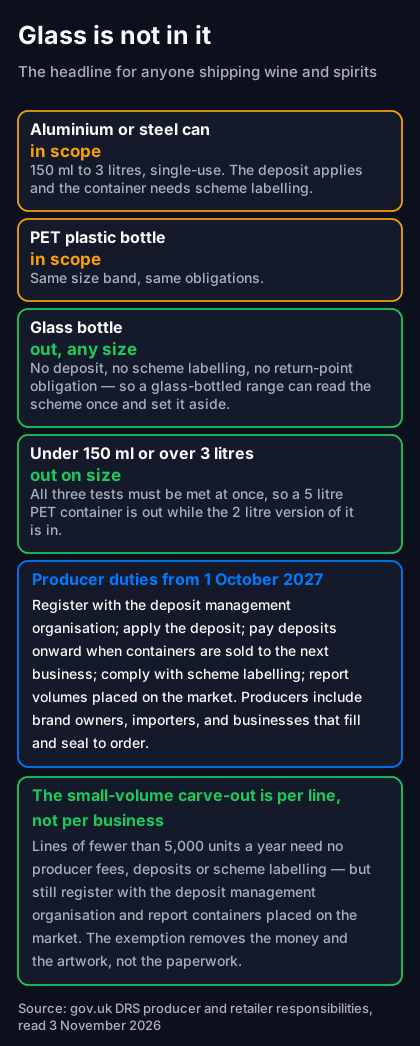
From 1 October 2027 a refundable deposit applies to single-use drinks containers in England, Northern Ireland and Scotland — aluminium, steel and PET between 150 millilitres and 3 litres. Glass is not in scope, which is the headline for anyone shipping wine and spirits. This sets out which containers are covered, what producers and retailers each owe, the small-volume exemption, and the reverse flow it creates.
What is the deposit return scheme?
The deposit return scheme puts a refundable deposit on certain single-use drinks containers, charged at the till and refunded when the empty container is returned. It is a closed loop with money in it: the deposit travels up the supply chain with the drink and comes back down when the container does.
That makes it structurally different from the recycling rules around it. Extended producer responsibility charges a producer for packaging it puts on the market; a deposit scheme makes the consumer temporarily out of pocket and gives shops a reason to take containers back.
For businesses the obligations split along the supply chain rather than by size. Producers apply and account for deposits; retailers charge them, refund them and in most cases host a return point.
When does it start, and where?
From 1 October 2027, in England, Northern Ireland and Scotland. Gov.uk's producer and retailer guidance is the current source, and it describes the obligations as beginning on that date rather than phasing in by business size.
The date is far enough out to be easy to ignore and close enough that labelling decisions made now will outlive it. Scheme labelling is a producer obligation, which means artwork, print runs and packaging stock ordered in the meantime all have a deadline attached to them.
Three nations rather than four is the other thing to carry away. A producer supplying the whole UK will be operating a scheme in part of it, which is the same devolved asymmetry our digital waste tracking article describes for waste reporting timetables.
Which containers are in scope?
Three materials and a size band. A container is in scope where it is made wholly or mainly from aluminium or steel, or from PET plastic, holds between 150 millilitres and 3 litres, and is likely to be used only once or for a short period.
| Container | In scope? |
|---|---|
| Aluminium or steel can, 150 ml to 3 litres | Yes |
| PET plastic bottle, 150 ml to 3 litres | Yes |
| Glass bottle, any size | No |
| Container under 150 ml or over 3 litres | No |
| Reusable container not single-use | No |
All three tests have to be met at once, which is why a product range can straddle the line. The same brand in a can is in and in a glass bottle is out, and a 5 litre PET container is out on size while the 2 litre version of it is in.
Is glass included?
No, and for anyone shipping wine and spirits that is the headline. The scheme names aluminium, steel and PET; glass is absent from the list, so a glass-bottled range carries no deposit, no scheme labelling and no return-point obligation.
That matters commercially rather than technically. A producer whose output is glass can read the scheme once and set it aside, while a producer with a canned line alongside a bottled one has to operate the scheme for part of its range and not the rest — which is harder than operating it for everything.
Our wine and spirits work is almost entirely glass, so for most of those consignments nothing changes. The AWRS approval rules remain the compliance question that actually governs those sales.
Who counts as a producer?
Whoever puts the drink into UK circulation, which the guidance treats as three groups: manufacturers of in-scope drinks, typically the brand owner; importers of drinks into the UK; and businesses that fill and seal drinks containers to order.
The third group is the one that surprises people, because contract filling makes the filler a producer in its own right. A business that fills cans for other brands is not merely a service provider under this scheme.
Brand owners should not assume an importer or a filler absorbs the obligation. As with EPR for packaging, more than one business can be in scope for the same unit in different roles, and a contract silent on the point leaves each assuming the other registered.
What must a producer do?
Five things, and four of them are administrative rather than physical.
- Register with the deposit management organisation before the scheme starts.
- Apply the deposit to every container in scope.
- Pay the deposits collected to the deposit management organisation when containers are sold to the next business in the chain.
- Comply with scheme labelling requirements on the container itself.
- Report the number of drinks placed on the market.
Item three is the cash-flow one. The deposit is collected from the next business down the chain and handed to the scheme administrator, so a producer is briefly holding money that is not its own on every unit it sells — which is an accounting change as much as a compliance one.
Is there a small-volume exemption?
A partial one, and it is per product line rather than per business. Lines of fewer than 5,000 units a year do not need producer fees, deposits or scheme labelling.
What survives for those lines is registration and reporting: the producer still has to register with the deposit management organisation and report the number of containers placed on the market. So the exemption removes the money and the artwork but not the paperwork.
The per-line structure rewards knowing your volumes precisely. A producer with several small lines may find most of its range exempt and one line over the threshold, and the threshold is counted annually rather than at a point in time.
It also makes growth a labelling event. A line that sells 4,000 units this year and 6,000 next has crossed into deposits and scheme artwork, and the artwork cannot be applied retrospectively to stock already filled — so a producer close to the threshold is making a print decision about next year rather than reporting on last year. The same arithmetic applies in reverse: a line that falls back below the threshold does not shed the labelling already on the shelf.
What must a retailer do?
Charge the deposit, refund it, and account for the containers in between. Every retailer selling in-scope drinks pays the deposit to producers or wholesalers when buying stock and charges it to consumers at the point of sale.
| Duty | Producer | Retailer |
|---|---|---|
| Register with the deposit management organisation | Yes | Yes |
| Apply the deposit to containers | Yes | Charges it at the till |
| Pay deposits onward | To the scheme | To producers or wholesalers |
| Scheme labelling | Yes | No |
| Report volumes placed on the market | Yes | No |
| Host a return point | No | Most food and drink retailers |
The refund can be given as a voucher, by card or in cash, and retailers also have to display information so customers understand how the scheme works. Neither is onerous on its own; together with the storage they add up to counter space and staff time.
Does every shop have to take containers back?
Most food and drink retailers will. Supermarkets, grocery stores, convenience stores and newsagents selling in-scope drinks must host a return point unless they qualify for an exemption, and the return point may be manual or an automated reverse vending machine.
Hosting one brings obligations that read like a small logistics operation: refund the deposit at the point of return, store the returned containers until they are collected, and keep the information display current. Empty containers accumulate at a predictable rate and have to live somewhere before collection.
That storage is the part worth planning now, because it is the part that takes floor space. A return point in a small shop competes directly with stock for the room behind the counter, and the collection frequency is what decides how much room it needs.
What does it mean for the way drinks move?
It adds a reverse flow to a supply chain that previously ran one way. Full containers go out and empty ones come back — from thousands of return points to counting and processing — which is a collection network rather than a delivery one.
Reverse logistics behaves differently from outbound in every respect that matters: volumes are unpredictable per site, the goods have no resale value, and the economics depend on fill rate rather than on speed. Our reverse logistics article covers why that direction costs more than people expect.
For producers there is also a stock-handling consequence before the scheme starts. Labelled and unlabelled versions of the same product cannot be mixed in a pick face, so the changeover needs separation in the warehouse as well as a date in the diary.
Where do we stand in this?
We are a carrier, not a producer, retailer or scheme administrator. We do not apply deposits, we hold no registration with a deposit management organisation, and nothing we issue evidences a deposit position.
What we can say usefully is what the scheme does not touch: glass is out, so the wine and spirits consignments on our alcohol delivery and alcohol courier work are largely unaffected, and the duty-point rules in AWRS remain the governing compliance question for those sales.
Where we would be involved is the reverse leg, and that is ordinary collection work rather than a scheme role — see pallet delivery for the outbound side and who unloads for the part that decides how long a collection takes.
Questions
- What is the deposit return scheme?
- A refundable deposit on certain single-use drinks containers, charged at the till and refunded when the empty container is returned. It is a closed loop with money in it: the deposit travels up the supply chain with the drink and comes back down when the container does. Producers apply and account for deposits; retailers charge them, refund them and in most cases host a return point.
- When does the deposit return scheme start?
- 1 October 2027, in England, Northern Ireland and Scotland — three nations rather than four. The obligations begin on that date rather than phasing in by business size. The date is far enough out to be easy to ignore and close enough that labelling decisions made now will outlive it, because scheme labelling is a producer obligation and packaging stock ordered in the meantime has a deadline attached.
- Which drinks containers are in scope?
- Those made wholly or mainly from aluminium or steel, or from PET plastic, holding between 150 millilitres and 3 litres, and likely to be used only once or for a short period. All three tests must be met at once, so a range can straddle the line: the same brand in a can is in and in a glass bottle is out, and a 5 litre PET container is out on size while the 2 litre version is in.
- Is glass included in the deposit return scheme?
- No. The scheme names aluminium, steel and PET; glass is absent, so a glass-bottled range carries no deposit, no scheme labelling and no return-point obligation. That matters commercially: a producer whose output is glass can read the scheme once and set it aside, while one with a canned line alongside a bottled one has to operate the scheme for part of its range and not the rest.
- Who counts as a producer under the scheme?
- Three groups: manufacturers of in-scope drinks, typically the brand owner; importers of drinks into the UK; and businesses that fill and seal drinks containers to order. The third surprises people, because contract filling makes the filler a producer in its own right. More than one business can be in scope for the same unit in different roles, so a contract silent on the point leaves each assuming the other registered.
- Is there an exemption for small drinks producers?
- A partial one, and it is per product line rather than per business: lines of fewer than 5,000 units a year need no producer fees, deposits or scheme labelling. Registration and reporting survive — the producer still registers with the deposit management organisation and reports containers placed on the market. The exemption removes the money and the artwork but not the paperwork.
- Does every shop have to take containers back?
- Most food and drink retailers will. Supermarkets, grocery stores, convenience stores and newsagents selling in-scope drinks must host a return point unless they qualify for an exemption, and it may be manual or an automated reverse vending machine. Hosting one means refunding deposits at the point of return, storing returned containers until collection, and keeping an information display current.
Explore more
More from the blog
- Van Size Guide: Which Courier Vehicle Do You Need?
- Heathrow Cargo: Complete Shipper's Guide to UK's La…
- The nine ADR dangerous goods classes, and what they…
- Waybills compared: air, sea and road, and what each…
- AWRS: who needs approval to sell alcohol wholesale,…
- Bill of lading or CMR note: which one your shipment…