
Hiring a refrigerated van versus using a carrier: what transfers to you
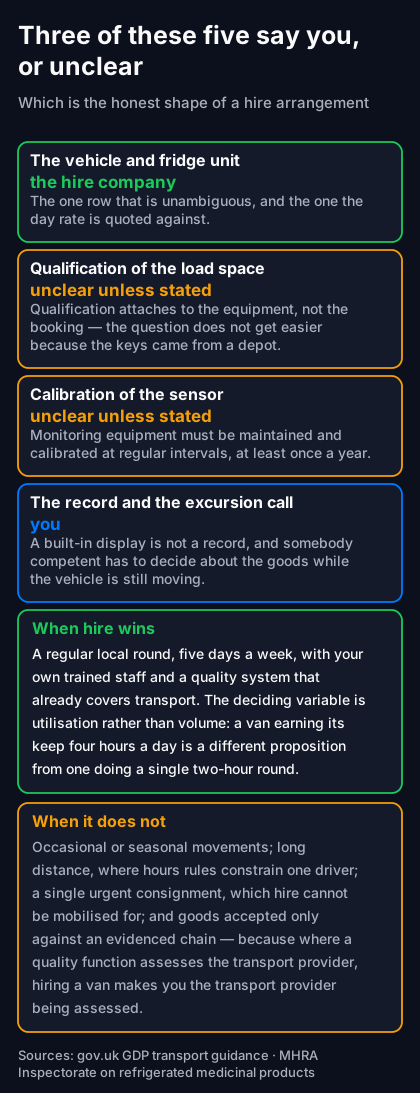
Hiring a refrigerated van gets you a vehicle that can hold a temperature and the whole of the responsibility for proving that it did. Qualification attaches to the equipment, monitoring devices need calibrating at least annually, the consignment record is yours, and so is the excursion decision — none of which arrives with the keys. This sets out what transfers to you when you hire, and when that is the right trade.
What does hiring a refrigerated van actually get you?
A vehicle that can hold a temperature, and the whole of the responsibility for proving that it did. Those two things arrive together, and the second is the one that is easy to miss when comparing a day rate against a delivery quote.
A hire company supplies equipment. It does not supply a quality system, a calibration regime, an excursion procedure or a driver who knows what to do when the display reads wrong — and for a regulated product each of those is part of what makes the movement acceptable.
So the comparison is not "van hire against courier". It is "van hire plus everything around it, against a service that already includes the everything".
What does qualification mean for hired equipment?
That the equipment has been shown to be fit for its intended use before it is relied on. Gov.uk's GDP guidance on transport treats thermal packaging, temperature-controlled containers and temperature-controlled vehicles as equipment subject to qualification, used so that correct transport conditions are maintained.
Qualification attaches to the equipment, not to the booking. A van hired for three days is the same object whether it is hired or owned, and the question "has this load space been shown to hold the required temperature under representative conditions?" does not become easier to answer because the keys came from a depot.
It also has a seasonal dimension, which hire makes awkward. Mapping has to take seasonal variation into account, and a vehicle hired in July is being relied on in the hardest conditions of the year — see temperature mapping for what that exercise involves and who owes it.
Who calibrates the monitoring?
Somebody has to, at least annually, and the hire agreement rarely says who. Equipment used for temperature monitoring during transport has to be maintained and calibrated at regular intervals, at least once a year.
| Item | Who it belongs to when you hire |
|---|---|
| The vehicle and its refrigeration unit | The hire company |
| Qualification evidence for the load space | Unclear unless the contract says |
| Calibration of the temperature sensor | Unclear unless the contract says |
| The consignment temperature record | You, as the operator of the movement |
| The excursion decision | You |
Three of those five rows say "you" or "unclear", which is the honest shape of the arrangement. A hire contract is a contract about a vehicle; the regulated obligations sit outside it.
Who holds the record?
Whoever is accountable for the movement — and if you hired the van and drove it, that is you. The record has to be legible, attributable to the consignment, and produced from a device whose calibration can be evidenced.
A built-in display is not a record. A number on a dashboard at the moment somebody looked at it tells you nothing about the two hours before, which is why a logger with a downloadable trace is what a recipient's quality function actually asks for.
And the record has to survive the journey administratively as well as physically. A trace that cannot be tied to a specific consignment, date and vehicle is data rather than evidence.
Retention is the quiet part of it. A temperature record is useful on the day and necessary months later, when a recipient queries a batch or an inspection asks how a particular movement ran — which means it has to be filed somewhere findable by consignment rather than left on a device that gets re-hired to somebody else. A business that hires vehicles occasionally is the one most likely to lose the trace, because nothing in its routine is built around downloading one.
What happens on an excursion?
A decision has to be made about the goods, by somebody competent to make it, usually while the vehicle is still moving. That is the part hire does not supply.
The MHRA Inspectorate's own guidance on refrigerated medicinal products treats temperature management, packing and the use of third-party couriers as a connected set of considerations rather than separate ones — because an excursion is where all three meet.
In practice the question is procedural: who is told, how quickly, what is quarantined, and who decides whether the product may still be used. A business hiring a van for a week has to have answered those questions before the first collection, not during the first excursion.
Does your insurance cover the goods?
That is a question for your own insurer, and it is the one most often assumed rather than asked. Hire cover and goods cover are different things: a policy arranged with a vehicle is concerned with the vehicle, and goods carried in a vehicle you are driving yourself are not travelling under anybody else's goods-in-transit arrangement.
For temperature-sensitive goods there is a further question behind that one: whether loss caused by a temperature excursion is covered at all, as distinct from loss caused by damage or theft. The two are not the same peril and are not always treated the same way.
We are not insurance advisers and this page is not advice. The practical point is that the answer should be in writing from your insurer before the goods are loaded, because the alternative is discovering the position during a claim.
Who may drive it, and under what rules?
Entitlement and hours both bite, and the second surprises people more than the first. A refrigerated 3.5-tonne van is a goods vehicle, and driving one for your business is work rather than a trip.
Our own transport versus a courier comparison sets out the licence entitlement and drivers' hours questions in detail, and they apply unchanged to a refrigerated vehicle. If the journey is international and the vehicle is over 2.5 tonnes for hire and reward, the tachograph rules reach it too.
Competence is the extra one for cold chain. A driver has to know what the display should read, what to do if it does not, and why the door should not be open while a conversation happens at a delivery point.
What does the cost actually include?
Less than the day rate implies, and the gaps are consistent. Pricing the two options fairly means pricing the same scope, which is where most comparisons go wrong.
- The driver's time, at the rate you actually pay, including the return leg.
- Fuel and tolls, plus any charges the route picks up.
- Pre-cooling, which takes time before the first collection.
- The monitoring device and its calibration, if the hire does not include one.
- The empty return, which a carrier's price has already absorbed into its own routing.
The last item is the structural one. A hired van goes out and comes back; a carrier's vehicle is on a route with other work on it, and that difference is why the arithmetic usually favours hire only at high utilisation.
When is hiring the right answer?
When the work is regular, local and yours alone — which is a real and common shape.
A business running the same chilled round five days a week, with its own trained staff and a quality system that already covers transport, is not buying much from a carrier that it does not already have. At that point a vehicle on contract hire is a sensible capital decision.
The deciding variable is utilisation rather than volume. A van earning its keep four hours a day is a different proposition from one doing a single two-hour round, however important that round is, and a vehicle standing idle costs the same as one working.
When is it the wrong answer?
When the requirement is occasional, long-distance, or evidenced to somebody else's standard.
| Shape of the requirement | Usually better served by |
|---|---|
| Regular local round, own staff, own quality system | Hire or own vehicle |
| Occasional or seasonal movements | A carrier |
| Long-distance, where hours rules constrain one driver | A carrier |
| Goods accepted only against an evidenced chain | A carrier under its own arrangements |
| A single urgent consignment | A carrier — hire cannot be mobilised in time |
The fourth row is the one that settles most pharmaceutical cases. Where a recipient's quality function assesses the transport provider, hiring a van makes you the transport provider being assessed.
Where do we stand in this?
We are one of the two options, so take the comparison above as written by an interested party and price both. What we have tried to do is state the obligations that travel with the equipment rather than the ones that favour us.
Plainly on credentials: we are not a wholesale dealer, we hold no GDP certification, and where a movement has to run under a validated chain that is arranged with a partner operating under its own authorisation. Our licences page lists what we hold and what we do not.
For the work itself see temperature-controlled delivery, for the terminology cold chain versus temperature-controlled, and for the hardest version of the problem clinical trial logistics, where the chain of custody matters as much as the temperature.
Questions
- What do you take on when you hire a refrigerated van?
- A vehicle that can hold a temperature, and the whole of the responsibility for proving that it did. A hire company supplies equipment; it does not supply a quality system, a calibration regime, an excursion procedure or a driver who knows what to do when the display reads wrong. The comparison is not van hire against a courier — it is van hire plus everything around it against a service that already includes it.
- Does a hired refrigerated vehicle need qualification?
- GDP guidance treats thermal packaging, temperature-controlled containers and temperature-controlled vehicles as equipment subject to qualification, used so that correct transport conditions are maintained. Qualification attaches to the equipment rather than the booking: the question of whether this load space holds the required temperature under representative conditions does not get easier because the keys came from a depot.
- Who calibrates the temperature monitoring in a hired van?
- Somebody must, at least annually — and the hire agreement rarely says who. Equipment used for temperature monitoring during transport must be maintained and calibrated at regular intervals, at least once a year. Of the five things that matter here, the vehicle and refrigeration unit clearly belong to the hire company; qualification evidence and sensor calibration are unclear unless the contract says, and the record and the excursion decision are yours.
- Who holds the temperature record if I hire the van?
- Whoever is accountable for the movement, which if you hired and drove it is you. The record has to be legible, attributable to the consignment, and produced by a device whose calibration can be evidenced. A built-in display is not a record: a number on a dashboard at the moment somebody looked tells you nothing about the two hours before, which is why a downloadable trace is what a recipient's quality function asks for.
- Does my insurance cover goods in a van I have hired?
- That is a question for your own insurer, and the one most often assumed rather than asked. Hire cover and goods cover are different things, and goods in a vehicle you drive yourself are not travelling under anybody else's goods-in-transit arrangement. There is a further question behind it for temperature-sensitive goods: whether loss caused by an excursion is covered at all, as distinct from damage or theft.
- When does hiring a refrigerated van make sense?
- When the work is regular, local and yours alone — a business running the same chilled round five days a week, with trained staff and a quality system that already covers transport, is not buying much from a carrier it does not already have. The deciding variable is utilisation rather than volume: a van earning its keep four hours a day is a different proposition from one doing a single two-hour round.
- When is a carrier the better option for chilled goods?
- When the requirement is occasional or seasonal, long-distance enough that drivers' hours constrain a single driver, urgent enough that hire cannot be mobilised in time, or where the recipient accepts goods only against an evidenced chain. That last case settles most pharmaceutical decisions: where a quality function assesses the transport provider, hiring a van makes you the transport provider being assessed.