
Direct Vision Standard: which lorries need a London safety permit
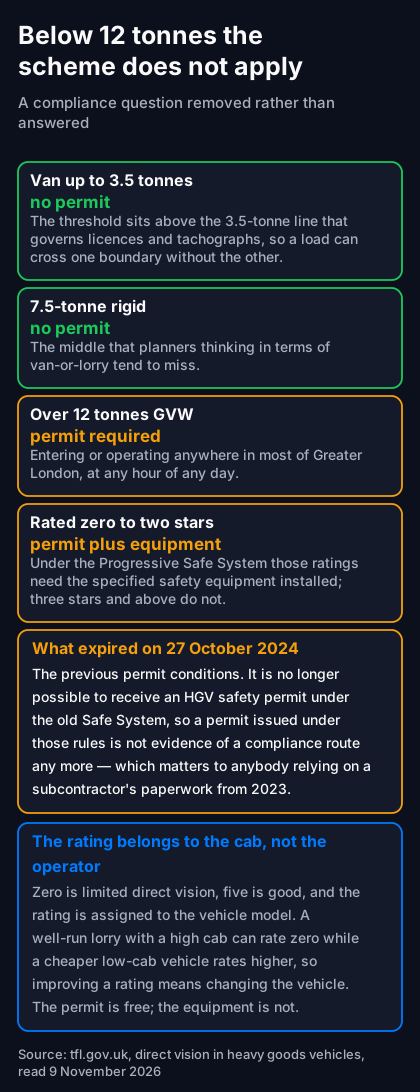
The Direct Vision Standard rates how much a lorry driver can see directly from the cab and turns that into a permit requirement: lorries over 12 tonnes gross vehicle weight need an HGV safety permit to enter or operate in Greater London, 24 hours a day, every day of the year. The permit is free; the equipment a low-rated cab needs is not. This sets out the threshold, the star ratings, what changed on 27 October 2024, and why a smaller vehicle avoids the question entirely.
What is the Direct Vision Standard?
The Direct Vision Standard rates how much a lorry driver can see directly out of the cab, with their own eyes rather than through a camera or mirror, and turns that rating into a permit requirement for Greater London. It exists because the vehicles with the worst direct vision are over-represented in collisions with people walking and cycling.
It is a permit scheme rather than a charge. Unlike the Congestion Charge or ULEZ, the question is not what you pay but whether the vehicle is allowed in at all.
And it is about the cab, not the load. A perfectly loaded, perfectly compliant lorry with a zero-star cab and no permit is not allowed to operate in Greater London, which makes this a vehicle-selection question before it is a routing one.
Which vehicles need a permit?
Lorries over 12 tonnes gross vehicle weight entering or operating in Greater London, per TfL. Below that, the scheme does not apply.
| Vehicle | Needs an HGV safety permit? |
|---|---|
| Van up to 3.5 tonnes | No |
| 7.5-tonne rigid | No |
| Lorry over 12 tonnes GVW | Yes |
| Over 12 tonnes, zero to two stars | Yes, and with the required safety equipment fitted |
| Over 12 tonnes, no permit | Penalty charge |
Twelve tonnes is the threshold that matters, and it sits above the 3.5-tonne line that governs licences and tachographs. So a load can cross one regulatory boundary without crossing the other, and planners who think in terms of "van or lorry" miss the middle.
What do the star ratings mean?
A scale from zero to five, measuring direct vision from the cab. Zero indicates limited visibility and five represents good visibility, with the rating assigned to the vehicle model rather than earned by the operator.
The rating is therefore a fact about the cab design, not about how well the vehicle is run. A well-maintained, well-driven lorry with a high cab and a long bonnet can rate zero, and a cheaper vehicle with a low cab can rate higher.
That is what makes the standard awkward for operators: improving the rating means changing the vehicle, not changing the practice. What the scheme offers instead is a route to compliance through equipment, which is how a low-rated cab stays legal without being replaced.
Ratings are published per model, so they are knowable in advance rather than discovered at a checkpoint. An operator planning London work can tell which of its vehicles will need the equipment package before buying anything, and a buyer can ask which vehicle is allocated rather than which fleet is compliant on average.
What changed on 27 October 2024?
The old compliance route closed. Previous permit conditions expired on 27 October 2024, and it is no longer possible to receive an HGV safety permit under the previous Safe System conditions.
What replaced them is the Progressive Safe System, under which vehicles rated zero, one or two stars must have specified safety equipment installed. Three stars and above do not need the equipment package.
The practical consequence is that a permit issued under the old rules is not evidence of anything now. Anybody relying on a sub-contractor's permit from 2023 is relying on a document that no longer exists as a compliance route.
Does the permit cost anything?
No. Applying for a permit is free of charge, which removes the usual excuse for not having one.
The cost sits in the equipment rather than the paperwork. A zero-star vehicle needs the Progressive Safe System package fitted, and that is a per-vehicle capital cost with a lead time; the permit itself is an application.
So a fleet with the right vehicles has an administrative task, and a fleet with low-rated cabs has a procurement one. Those are very different problems behind the same requirement.
It also changes how a quote should be read. An operator absorbing the equipment cost across a London-heavy fleet prices it in; one that does the occasional London job on a low-rated vehicle has an incentive to hope nobody checks, and that incentive is the thing a buyer is actually choosing between.
What happens without one?
A penalty charge. Driving a heavy goods vehicle within most of Greater London without a valid permit risks a penalty charge notice of up to £550, reduced to £275 if paid within 14 days.
The exposure is per journey rather than per year, which is what makes it expensive for a vehicle doing regular London work. It is also enforced by camera against the registration, so there is no version of this that depends on being stopped.
For a sender the risk is indirect but real: a non-compliant vehicle turning up means either a penalty somebody pays or a delivery that does not happen. Neither outcome is improved by the sender having assumed the question was settled, which is why it is worth one sentence in a booking.
When and where does the scheme apply?
Most of Greater London, 24 hours a day, every day of the year. There is no off-peak, no weekend relief and no overnight window in which an unpermitted lorry becomes acceptable.
That distinguishes it from almost every other London scheme. The Congestion Charge has hours, ULEZ has standards a compliant vehicle meets permanently, and lorry route controls have curfews — this one simply applies.
Our road charges on a delivery article covers the charges that follow the route and the vehicle; this is the one that decides admission rather than price.
Whose obligation is the permit?
The operator of the vehicle, which on a subcontracted movement is not the business that booked the delivery. That split is where assumptions do damage.
A freight buyer cannot hold a permit, because permits attach to vehicles and operators. What a buyer can do is ask whether the vehicle allocated to a London job is permitted, and treat a vague answer as an answer.
For anything over 12 tonnes we are the buyer in that chain too: that work goes to partner carriers operating under their own operator licences and their own permits, and we hold neither.
Does this make a smaller vehicle better for London?
Often, yes — and for several reasons at once, of which the permit is only the most absolute. Below 12 tonnes the scheme does not apply, which removes a compliance question entirely rather than answering it.
| Constraint | Van up to 3.5t | Lorry over 12t |
|---|---|---|
| HGV safety permit | Not required | Required, 24/7 |
| Drivers' hours and tachograph | Not on UK-only work | Yes |
| Operator licensing | Not for a 3.5t van | Yes |
| Street access and turning | Most addresses | Often restricted |
| Payload | Small — the real constraint | Large |
The last row is the honest counterweight. A van avoids four compliance questions and then runs out of payload, which is exactly the trade our van payload article sets out: the plated figure is the whole vehicle, and what is left for the load is smaller than the headline suggests.
What else constrains a city delivery?
Three things beyond the permit, and they tend to bite in combination rather than alone.
- Access — street width, turning circles, height restrictions and loading bays that were designed for smaller vehicles.
- Timing — delivery windows set by the receiving premises rather than by the road network.
- Unloading — whether there is anything at the far end to take a pallet off a vehicle.
The third is the one that most often decides vehicle choice in practice. A tail lift and a pallet truck make a kerbside delivery possible where a forklift is unavailable, and that pushes the job toward a van or a small rigid regardless of what the permit scheme says — see who unloads.
What should a sender ask before a London job?
Four questions, and the first two take a minute.
- Is the vehicle over 12 tonnes? If not, the permit question does not arise.
- If it is, is there a current permit under the Progressive Safe System rather than the expired conditions?
- Can the vehicle physically reach the address, and turn once it is there?
- Who is unloading, and with what?
A load that fits a van is simpler on all four counts, which is why splitting a consignment is sometimes cheaper than upgrading the vehicle. When your load is too big for a van covers the point at which that stops being true.
Where do we stand in this?
We run vans, so for the overwhelming majority of our London work the Direct Vision Standard does not apply — and saying that is more useful than claiming a compliance achievement we have not had to make.
Where a consignment genuinely needs a vehicle over 12 tonnes, the work goes to partner carriers under their own operator licences and their own safety permits. We do not hold an operator licence and we do not hold HGV safety permits; our licences page lists what we do hold with the register that proves it.
What we can do is answer the vehicle question honestly before a job rather than after it. For the capacity side see van sizes compared and pallet sizes and vehicle capacity, and for how the load has to be restrained once the vehicle is chosen, load securing.
Questions
- What is the Direct Vision Standard?
- A scheme that rates how much a lorry driver can see directly out of the cab — with their own eyes rather than through cameras or mirrors — and turns that rating into a permit requirement for Greater London. It is a permit scheme rather than a charge: unlike the Congestion Charge or ULEZ, the question is not what you pay but whether the vehicle is allowed in at all. It concerns the cab, not the load.
- Which vehicles need an HGV safety permit in London?
- Lorries over 12 tonnes gross vehicle weight entering or operating in Greater London. Below that the scheme does not apply, so a 3.5-tonne van and a 7.5-tonne rigid need no permit. Twelve tonnes sits above the 3.5-tonne line that governs licences and tachographs, so a load can cross one regulatory boundary without crossing the other.
- What do the Direct Vision Standard star ratings mean?
- A scale from zero to five measuring direct vision from the cab, where zero indicates limited visibility and five good visibility. The rating belongs to the vehicle model rather than being earned by the operator, so a well-run lorry with a high cab can rate zero while a cheaper low-cab vehicle rates higher. Improving a rating means changing the vehicle, not the practice.
- What changed for HGV safety permits on 27 October 2024?
- The old compliance route closed: previous permit conditions expired on 27 October 2024 and it is no longer possible to receive a permit under the previous Safe System conditions. The Progressive Safe System replaced them, under which vehicles rated zero, one or two stars must have specified safety equipment installed. A permit issued under the old rules is no longer evidence of a compliance route.
- How much does an HGV safety permit cost?
- Applying for a permit is free of charge. The cost sits in the equipment rather than the paperwork: a zero-star vehicle needs the Progressive Safe System package fitted, which is a per-vehicle capital cost with a lead time. A fleet with the right vehicles has an administrative task; a fleet with low-rated cabs has a procurement one.
- What is the penalty for no HGV safety permit?
- Driving a heavy goods vehicle within most of Greater London without a valid permit risks a penalty charge notice of up to £550, reduced to £275 if paid within 14 days. The exposure is per journey rather than per year, and it is enforced by camera against the registration, so it does not depend on being stopped.
- Does the scheme have off-peak hours?
- No. It covers most of Greater London 24 hours a day, every day of the year — no off-peak, no weekend relief and no overnight window in which an unpermitted lorry becomes acceptable. That distinguishes it from the Congestion Charge, which has hours, and from lorry route controls, which have curfews. This one simply applies.
Explore more
More from the blog
- UK Government Spends £166B on Logistics: What It Me…
- IPAFFS pre-notification: what the border needs befo…
- Do your goods need an export licence, and who has t…
- Inland border facilities: what they do, and what ch…
- Import VAT and Postponed VAT Accounting: How It Is…
- Road Charges on a UK Delivery: What They Are, and W…