
Incident hardware delivery: what to arrange before you need it
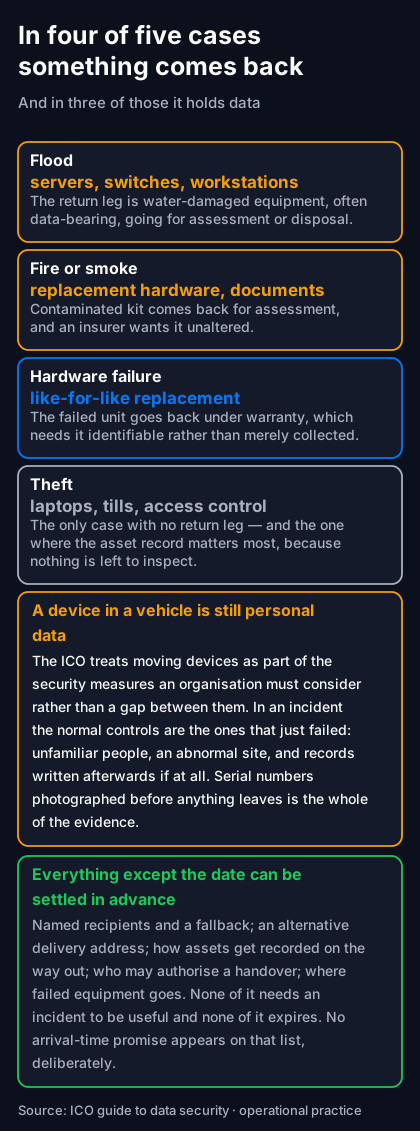
An incident delivery differs from an urgent one in the destination rather than the speed: the address may be flooded, cordoned or powerless, and the contact who knows is dealing with something else. Most incident jobs are two movements — replacement equipment in, failed equipment out — and the equipment coming back usually holds data. This sets out what to settle in advance, who signs, and why the data-protection question travels with the hardware.
What makes an incident delivery different from an urgent one?
The destination, not the speed. An ordinary urgent job has a known address, a known contact and a known way in; an incident job has an address that may be flooded, cordoned, powerless or closed, and a contact who is dealing with something else.
So the hard part is rarely the driving. It is establishing where the equipment can actually be received, by whom, and whether that place is the one on the order — questions that an urgent booking form does not ask.
The second difference is direction. Most incident jobs are two movements: replacement equipment in, failed or damaged equipment out, and the second half is the one nobody plans.
What usually has to move?
Equipment that a business cannot operate without, which in practice means a short and predictable list.
| Incident | What typically moves | The return leg |
|---|---|---|
| Flood or water ingress | Servers, switches, workstations | Water-damaged kit, often data-bearing |
| Fire or smoke | Replacement hardware, documents | Contaminated equipment for assessment |
| Theft or burglary | Laptops, tills, access control | Nothing — it has gone |
| Hardware failure | Like-for-like replacement | The failed unit, usually under warranty |
| Site loss or closure | Everything portable, to a temporary site | A second move back, later |
Read the third column. In four of the five cases something comes back, and in three of those it holds data — which is what turns a delivery into a chain-of-custody job.
Why is the destination the hard part?
Because its state is unknown and changing. A site that was accessible when the order was placed may be cordoned by the time a vehicle arrives, and the person who knows has stopped answering the phone they usually answer.
The practical answer is a named alternative, decided at booking rather than at the door. A second address — another branch, a director's office, a temporary unit — converts a failed delivery into a successful one at no extra cost.
Access is the other half. Equipment arriving at a site with no power may need to be left somewhere dry and secure rather than installed, and whether that is acceptable is a decision for the customer, not the driver — see who unloads for the ordinary version of the same boundary.
What happens to the equipment being replaced?
It becomes a separate job with its own rules, and the commonest mistake is treating it as a by-product of the delivery. Failed, damaged or superseded equipment is either going back to a supplier under warranty, to an insurer's assessor, or for disposal.
Each of those destinations wants different paperwork. A warranty return needs the unit identifiable; an insurance assessment needs it unaltered; disposal needs a transfer document and a registered carrier.
Our waste carrier registration article covers who may lawfully move the last of those, and it is a different question from who may deliver the replacement.
Does data protection apply to hardware in transit?
Yes — a laptop, a server or a drive in a vehicle is personal data being processed, and the security obligation travels with it. The ICO's guide to data security treats the movement of devices as part of the security measures an organisation has to consider rather than a gap between them.
That matters most in an incident, because the normal controls are the ones that just failed. Equipment is being handled by people who do not usually handle it, leaving a site that is not operating normally, with records being written after the event if at all.
The cheap mitigation is a list. Serial numbers and asset tags recorded before anything leaves, against the names of whoever took them, is the whole of the evidence a later investigation will ask for — and it is almost never available afterwards.
Who signs for it?
Somebody named in advance, because the usual signatory may not be there. In an incident the receiving contact is frequently not the person on the account, and a driver holding equipment nobody is authorised to accept is a delivery that fails at the last metre.
- A named recipient, with a second name as a fallback.
- A phone number that will be answered, which may not be the office one.
- What to do if neither is reachable — decided before the vehicle leaves.
- Whether a signature is enough, or an identity check is required for data-bearing kit.
The fourth is the one worth deciding deliberately. For equipment holding personal data, a signature from whoever happens to be at the door is weaker evidence than a named handover, and the difference costs nothing to arrange at booking.
What breaks first, logistically?
Information, not capacity. Vehicles and drivers are usually findable; what is missing is an accurate description of what has to move, from where, to whom.
In practice the first three failures are the same ones every time: the equipment turns out to be heavier or larger than described, the destination is not where the order says, and nobody can confirm what went out.
All three are fixable before anything is loaded and almost unfixable afterwards, which is the argument for the pre-incident conversation below. Weight in particular decides which vehicle is sent — our van payload article covers why a rack of servers is a payload question rather than a volume one.
There is a fourth failure that only shows up later: nobody wrote down what left the building. During the event that feels like an acceptable omission, because the priority is obvious and the paperwork is not. Afterwards it is the only question anybody asks — the insurer wants the inventory, the supplier wants serial numbers for the warranty claim, and if any of the equipment held personal data the organisation needs to say where it went. A phone photograph of asset tags takes a minute and answers all three.
Can this be arranged in advance?
Most of it, and the part that cannot be arranged in advance is the part that matters least. What can be settled beforehand is everything except the date.
| Settled in advance | Left to the day |
|---|---|
| Named recipients and fallback contacts | Which address is actually usable |
| Alternative delivery addresses | What has failed |
| Asset-recording method for the return leg | How much of it there is |
| Who may authorise a handover | Timing |
| Where failed equipment goes | — |
A business that has answered the left-hand column once has converted an improvised job into a booked one. Nothing in that column needs an incident to be useful, and none of it expires.
Does insurance cover equipment in transit?
Carriage and the goods are separate questions, and the answer depends on whose arrangement applies. Goods moving with a carrier travel under that carrier's terms and limits; goods moved by the business itself are not travelling under anybody else's goods-in-transit arrangement at all.
For high-value equipment the gap between a standard limit and a replacement cost is the thing to establish before the movement rather than during a claim. Declaring a value is how that is done, and it is a conversation at booking.
We are not insurance advisers and this page is not advice. The useful point is that "it was in a van" is not a cover position, and an incident is a poor time to discover which cover applies.
What does a carrier need to know on the call?
Five things, and a caller who has them turns a vague request into a job.
- What the items are, with real weights and dimensions — a server rack and a box of laptops need different vehicles.
- Where from and where to, with the alternative address if the primary is doubtful.
- Who receives it, named, with a number that will be answered.
- Whether anything comes back, and where that goes.
- Whether the items hold data, which changes the handover and the record.
The fifth is the one most often left out and the one with the longest tail. Equipment that held personal data and cannot be accounted for afterwards is a data-protection problem long after the operational one is solved.
Where do we stand in this?
We move the equipment and produce the record; we do not assess damage, restore systems or advise on continuity planning. On the return leg we hold an upper tier waste carrier registration, so failed equipment going for disposal can move lawfully rather than needing a second supplier.
We make no response-time promise on this page, deliberately. What a carrier can honestly offer for an incident is a vehicle appropriate to the load, a named handover and a record of what moved — and anybody quoting a fixed arrival window for an address whose state is unknown is quoting a number they cannot control.
For the data-bearing side see chain of custody and IT equipment collection; for the aviation version of the same urgency, AOG parts delivery; and for why the return direction costs more than people expect, reverse logistics.
Questions
- What makes an incident delivery different from an urgent delivery?
- The destination rather than the speed. An urgent job has a known address, contact and way in; an incident job has an address that may be flooded, cordoned, powerless or closed, and a contact dealing with something else. The second difference is direction: most incident jobs are two movements — replacement equipment in and failed equipment out — and the second half is the one nobody plans.
- What happens to the equipment being replaced?
- It becomes a separate job with its own rules, and treating it as a by-product of the delivery is the commonest mistake. Failed or damaged equipment goes back to a supplier under warranty, to an insurer's assessor, or for disposal — and each wants different handling. A warranty return needs the unit identifiable, an assessment needs it unaltered, and disposal needs a transfer document and a registered carrier.
- Does data protection apply to hardware in transit?
- Yes. A laptop, server or drive in a vehicle is personal data being processed, and the ICO's guidance treats moving devices as part of the security measures an organisation must consider rather than a gap between them. It matters most in an incident, because the normal controls are the ones that just failed: unfamiliar people, an abnormal site, and records written afterwards if at all.
- Who should sign for equipment delivered during an incident?
- Somebody named in advance, because the usual signatory may not be there. Arrange a named recipient plus a fallback, a phone number that will actually be answered, and what to do if neither is reachable. For equipment holding personal data, decide whether a signature is enough or an identity check is needed — a signature from whoever is at the door is weaker evidence than a named handover.
- What goes wrong first in an incident delivery?
- Information, not capacity. Vehicles and drivers are usually findable; what is missing is an accurate description of what has to move, from where and to whom. The same three failures recur: the equipment is heavier or larger than described, the destination is not where the order says, and nobody can confirm what went out. All three are fixable before loading and nearly unfixable afterwards.
- Can incident logistics be arranged before anything happens?
- Everything except the date. Named recipients and fallbacks, alternative delivery addresses, the asset-recording method for the return leg, who may authorise a handover and where failed equipment goes can all be settled in advance. None of it needs an incident to be useful and none of it expires — a business that has answered those once has converted an improvised job into a booked one.
- Is equipment insured while it is being moved after an incident?
- Carriage and the goods are separate questions and the answer depends on whose arrangement applies: goods moving with a carrier travel under that carrier's terms and limits, while goods the business moves itself are not under anybody else's goods-in-transit arrangement. For high-value equipment, establish the gap between a standard limit and replacement cost before the movement, by declaring a value at booking.
Explore more
More from the blog
- UK Pharmaceutical Cold Chain Logistics: 2026 Compli…
- Commodity Codes Explained: How to Classify UK Impor…
- Heathrow Cargo: The Complete Guide for Freight Ship…
- Aerospace Courier UK — AOG & Parts Logistics Guide…
- Van Size Guide: Which Courier Vehicle Do You Need?
- Heathrow Cargo: Complete Shipper's Guide to UK's La…