
WEEE compliance for sellers: take-back, the DTS and producer registration
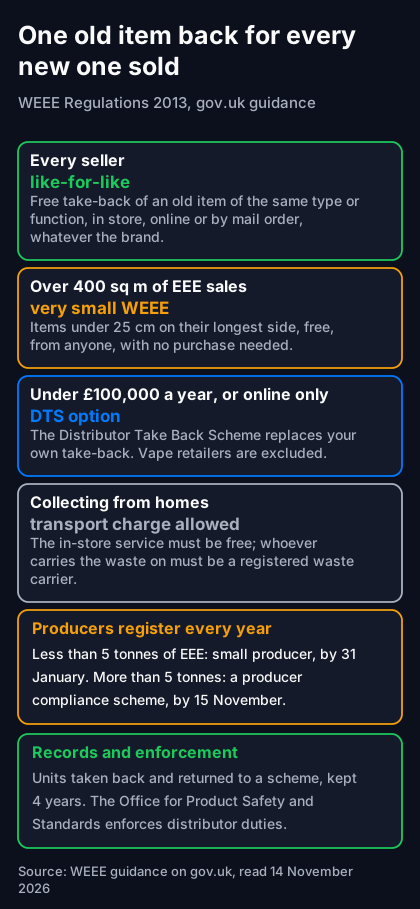
Any business that sells electrical or electronic equipment in the UK has duties under the WEEE Regulations: retailers must offer free like-for-like take-back, stores over 400 square metres must accept small items from anyone, and importers and own brands must register as producers. This sets out who counts as which, the 5-tonne producer line, the Distributor Take Back Scheme, and what happens to the old appliance once it is handed back.
What do the WEEE Regulations require of a business that sells electricals?
Two sets of duties, depending on the role. A producer pays for the collection and treatment of waste electricals through registration; a distributor, which includes every retailer, must offer customers a free way to hand back their old item when they buy a new one.
The law is the Waste Electrical and Electronic Equipment Regulations 2013, as amended by the WEEE (Amendment, etc.) Regulations 2025. They cover electrical and electronic equipment (EEE) in 15 broad categories, from large household appliances and IT equipment to lighting, tools, toys and vapes.
Some equipment sits outside them entirely. The gov.uk summary lists exclusions such as large-scale stationary industrial tools, large-scale fixed installations, implantable medical devices, equipment designed to be sent into space, and filament bulbs, although LED filament bulbs are covered.
Are you a producer, a distributor, or both?
Often both. A business is a producer when it puts EEE on the UK market under its own name or brings it in, and a distributor when it makes EEE available to someone else; one company that imports and sells direct carries both sets of duties.
| You | Role | Main duty |
|---|---|---|
| Make and sell EEE under your own brand in the UK | Producer | Register every year |
| Rebrand and resell someone else's equipment | Producer, unless the maker's brand appears on it | Register every year |
| Import EEE into the UK on a commercial basis | Producer | Register every year |
| Sell to UK end users from abroad by distance selling | Producer | UK authorised representative, or a compliance scheme |
| Run an online marketplace selling non-UK suppliers' EEE to UK households | Producer | Register and report that EEE |
| Sell EEE in a shop, online, by mail order or by phone | Distributor | Free take-back for customers |
A private individual who buys an item abroad for their own use is not a producer. For a non-UK maker selling through a UK importer or retailer, the first UK legal entity making the equipment available registers instead, which is why importers should check their supply chain before the compliance year starts.
How does producer registration work?
By weight placed on the UK market in a calendar year. Under 5 tonnes, a producer can register directly with its environmental regulator as a small producer; above that, it must join a producer compliance scheme (PCS), which takes on the financing of collection and treatment.
| Small producer | Compliance scheme member | |
|---|---|---|
| Weight of EEE a year | Less than 5 tonnes | More than 5 tonnes |
| Registers with | Environment Agency, NRW, NIEA or SEPA, through the WEEE online service | An approved PCS |
| Deadline | 31 January each year, or within 28 days of first placing EEE on the market | 15 November each year, or within 28 days if entering the market after that |
| Reports | Last year's EEE by category, household or non-household | EEE by category, as the scheme requests |
A small producer that passes 5 tonnes during the year must tell its regulator and join a scheme within 28 days, per the producer guidance. Every producer must also mark products with the crossed-out wheeled bin symbol and a date mark, publish reuse and treatment information within 1 year of placing new equipment on the market, give its registration number to the distributors it supplies, and keep records by category for at least 4 years. The weight of batteries inside the equipment is reported separately under the batteries rules.
What does like-for-like take-back mean?
When a customer buys a new household item, the seller must take back one old item of the same type or the same function, free, whatever brand it is and however the sale was made.
Gov.uk gives two examples: an old kettle when the customer buys a new kettle, and a video player when the customer buys a DVD player. The duty applies whether the sale happened in store, online or by mail order, and an in-store take-back has to give the customer at least 28 days to bring the old item in.
It is one item for one item, not an open door. A shop can choose to accept all kinds of electrical waste, but the regulations only require like-for-like, except for the large-store and vape rules below.
Do you have to collect the old appliance when you deliver a new one?
Not as such. The regulations require a free take-back route, and collecting the old item on delivery is one way of providing it; a free in-store service, an alternative collection point or membership of the Distributor Take Back Scheme are the others.
Where a retailer does collect from customers' homes, the retailer guidance allows a charge to cover the transport cost, while the in-store service itself must be free. The customer information the retailer publishes has to say which service it offers, and gov.uk names "collect on delivery" in that list.
The collection leg is a waste movement, not a parcel. Anyone transporting the waste to a treatment facility or a scheme collection point needs to be a registered waste carrier, and the hazardous waste rules may also apply. Our waste carrier registration article explains the tiers, and waste transfer notes covers the paperwork that follows the load.
What changes for stores over 400 square metres?
A retailer whose EEE sales area is greater than 400 square metres, counting aisle, display and shelf space, must also take back very small WEEE in store, free, from anyone, without requiring a purchase.
Very small WEEE means items of waste electrical and electronic equipment less than 25 cm on their longest side. This duty is not tied to a sale: the store must accept them whether or not the person has bought anything there.
A large store is exempt if it has joined the Distributor Take Back Scheme or if an assessment shows it already has an effective system. Separately, any retailer selling vapes must take back waste vapes in store or set up an alternative collection point.
Who can use the Distributor Take Back Scheme instead?
A distributor that sells less than £100,000 of EEE a year, or that only sells online, can join the Distributor Take Back Scheme (DTS) instead of running its own take-back. Vape retailers are excluded.
The DTS is operated by Valpak WEEE Retail Services Ltd. Members pay a fee that depends on the size of the business, whether it only sells online and how much EEE it sells, and the money goes towards supporting the recycling centres run by local authorities.
Gov.uk states that the fee covers a member's obligations until 31 December 2026, so a business relying on the DTS should check the position for the following year rather than assume it rolls over. A member still has to keep a record of what it tells customers about where to take their WEEE.
What must you tell customers?
Free written information on five points, whichever take-back route you use. Shops can use posters or leaflets; online retailers must publish it on their website.
- Which take-back service you provide, including collect on delivery.
- How customers can reuse and recycle electrical and electronic equipment.
- Why this waste needs to be separated from other waste.
- The damaging effects of not recycling electrical and electronic equipment.
- What the crossed-out wheelie bin symbol means.
Template customer information is free to download from gov.uk for retailers running their own scheme, and DTS members get theirs from the scheme. For the packaging around the same products, which is a separate producer regime, see EPR for packaging.
Where does the waste go after take-back?
Either to a producer compliance scheme, which arranges recycling or preparation for reuse at an Approved Authorised Treatment Facility (AATF), or to an AATF or scheme collection point in the retailer's own transport.
The scheme route may still carry a charge for collection and transport to the AATF or collection point. The own-transport route needs waste carrier registration. A retailer can also set up a designated collection facility (DCF), alone or with other distributors, but must then agree with a PCS to return the waste direct to an AATF; what an AATF does is covered in our AATF glossary entry.
Collected waste may be stored temporarily before disposal, but only within the storage conditions gov.uk links to, so a retailer holding take-back stock should check those before it lets items accumulate.
Is it household or business WEEE?
The product's design, specification and function decide, not who bought it. Equipment designed for both household and business use, known as dual use, is classed as household (B2C).
The classification guidance lets a distribution channel support a business (B2B) classification but never decide it alone, and a product must be classified one way or the other, not split. Its examples make the line concrete: a commercial coffee machine bought by a householder is still B2B; every vape and every photovoltaic panel is B2C; stadium floodlights and conveyor-belt toasters are B2B.
The distinction matters because producers report each stream separately and a compliance scheme finances them differently. Business equipment leaving an office is the case our WEEE Regulations glossary deals with.
What records are needed, and who enforces this?
Distributors must keep records of all electrical waste collected and disposed of, including the number of units received through take-back and how many went to a PCS, for 4 years. The Office for Product Safety and Standards (OPSS) enforces the distributor duties.
| Record | Who keeps it | How long |
|---|---|---|
| Units taken back, and how many returned to a PCS | Distributor | 4 years |
| Documents from the PCS or AATF on disposal | Distributor | 4 years |
| How customers were told about take-back | Distributor, DTS members included | 4 years |
| EEE placed on the market, by category | Producer | At least 4 years |
OPSS also enforces the crossed-out wheeled bin marking. A business that does not comply can be prosecuted and face an unlimited fine in a magistrates' court or the Crown Court, sometimes after warning letters or formal cautions.
Where do we stand in this?
We sit on the carriage side only. T&C Logistics is registered with the Environment Agency as an upper tier waste carrier, broker and dealer under CBDU654368, so we can move WEEE a business has gathered, with treatment at a partner-operated approved facility; see WEEE collection.
We are not a producer compliance scheme, not part of the Distributor Take Back Scheme, and do not run a designated collection facility or a treatment site, so we do not issue evidence notes, register producers or advise on whether a business has met its duties. Gov.uk and the OPSS are the sources for that. The register entry and everything else we hold is on our licences page.
Questions
- Do online retailers have to take back old electricals?
- Yes. The WEEE take-back duty applies however the sale is made, including online, mail order and phone. An online-only retailer can meet it by joining the Distributor Take Back Scheme instead of running its own take-back service, and it must publish its customer information on its website.
- What is like-for-like take-back under WEEE?
- When a customer buys a new household electrical item, the seller must take back one old item of the same type or the same function, free of charge and regardless of brand. Gov.uk's examples are an old kettle for a new kettle, and a video player for a new DVD player. In-store take-back must give the customer at least 28 days.
- Who can join the Distributor Take Back Scheme?
- A distributor that sells less than £100,000 of electrical and electronic equipment a year, or that only sells online, or both. Vape retailers are excluded. The scheme is run by Valpak WEEE Retail Services Ltd, and gov.uk states that the fee covers a member's obligations until 31 December 2026.
- When does a WEEE producer have to join a compliance scheme?
- When it places more than 5 tonnes of EEE on the UK market in a compliance year. Below that it can register directly with its environmental regulator as a small producer by 31 January each year. A small producer that passes 5 tonnes during the year must notify its regulator and join a scheme within 28 days.
- Can a retailer charge for collecting an old appliance from a customer's home?
- Gov.uk's retailer guidance says the in-store take-back service must be free, but a retailer can charge to cover transport costs if it is collecting items from customers' homes. Whoever carries the waste on to a treatment facility or collection point must be a registered waste carrier.
- What is very small WEEE?
- Waste electrical items less than 25 cm on their longest side. Retailers with an EEE sales area greater than 400 square metres must take these back in store free from anyone, without a purchase, unless they are in the Distributor Take Back Scheme or an assessment shows they already have an effective system.
- Who enforces the WEEE take-back rules?
- The Office for Product Safety and Standards enforces the distributor obligations and the crossed-out wheeled bin marking. A business that fails to comply can be prosecuted and receive an unlimited fine in a magistrates' court or the Crown Court, and may receive warning letters or formal cautions first.
Explore more
More from the blog
- Clinical trial logistics: who owns the obligation,…
- The CMR note: what it covers, and what it actually…
- Cross-docking: what it saves, and what it costs you
- Customs value: what has to go in, and who answers f…
- Deemed service by courier: when court papers count…
- What a lorry needs to deliver in London: the permit…