
Chilled and frozen food transport: what the rules require in England
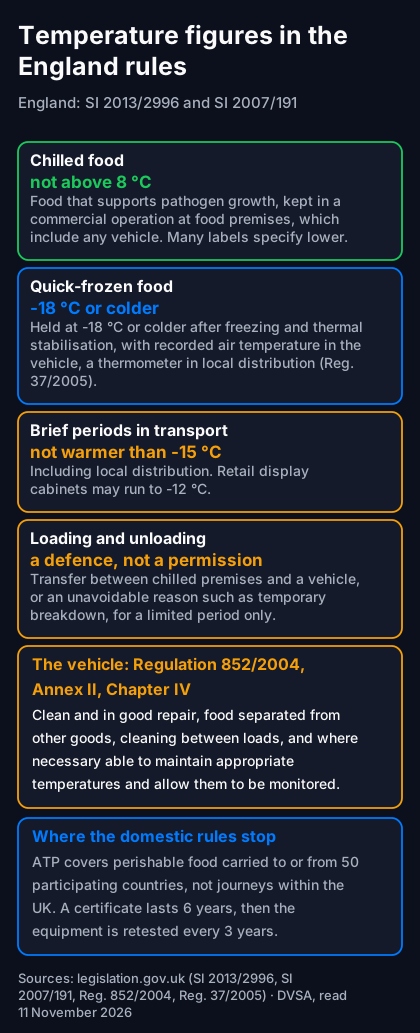
In England chilled food must not be kept above 8 °C in a delivery vehicle, because the Food Safety Act 1990 counts a vehicle as food premises and the 2013 England hygiene regulations make keeping such food warmer an offence. Quick-frozen food must stay at -18 °C or colder, with brief transport excursions allowed to -15 °C. This sets out what the law asks of the vehicle, the exemptions and defences, the home-delivery carve-out, food business registration, and where the ATP agreement starts.
Does food law apply to a van, or only to the kitchen?
It applies to the van. The Food Safety Act 1990 defines premises to include any vehicle, and counts transporting food for the purpose of sale as a commercial operation, so a delivery vehicle carrying food for a business is food premises for as long as the food is on board.
That definition, in section 1 of the Act, matters because the temperature rules below are written for "food premises". The vehicle requirements come from Regulation (EC) No 852/2004, retained in UK law; the temperature figures come from England-only regulations, which is why this article says England where it means England.
What does the hygiene regulation require of the vehicle?
Seven things, set out in Annex II, Chapter IV of Regulation 852/2004. Most are about contamination rather than temperature, and only the last one mentions temperature at all.
| Para | Requirement |
|---|---|
| 1 | Vehicles and containers kept clean, in good repair, and where necessary built to allow cleaning and disinfection |
| 2 | Receptacles not used for anything other than food where that may cause contamination |
| 3 | Effective separation where food travels with other goods, or different foods travel together |
| 4 | Bulk liquid, granulate or powder food in receptacles reserved for food, marked "for foodstuffs only" |
| 5 | Effective cleaning between loads after non-food or different food |
| 6 | Food placed and protected to minimise the risk of contamination |
| 7 | Where necessary, capable of maintaining appropriate temperatures and allowing them to be monitored |
Paragraph 7 has two separate duties. Holding the temperature is not enough; the vehicle has to let somebody see that it was held.
What temperature must chilled food travel at in England?
At or below 8 °C. Schedule 4 of the Food Safety and Hygiene (England) Regulations 2013 makes it an offence to keep food that can support the growth of pathogens or toxins, in the course of a commercial operation, at food premises above 8 °C.
Read with the 1990 Act, that puts the 8 °C line inside the vehicle. It is a legal ceiling, not a setting; many labels specify lower.
| Food | Figure | Source |
|---|---|---|
| Chilled, supports pathogen growth | Not above 8 °C | SI 2013/2996, Sch. 4 para 2 |
| Hot food for service or display | Not below 63 °C | SI 2013/2996, Sch. 4 para 6 |
| Quick-frozen, generally | -18 °C or colder | SI 2007/191, Sch. 2 |
| Quick-frozen, brief periods in transport | Not warmer than -15 °C | SI 2007/191, Sch. 2 para 2 |
| Quick-frozen, retail display cabinet | Not warmer than -12 °C | SI 2007/191, Sch. 2 para 2 |
The schedule does not apply to operations covered by Regulation 853/2004, the specific hygiene rules for food of animal origin, nor to food business operations on a ship or aircraft. Meat and fish from approved establishments sit under a different regime, not covered here.
Which foods are outside the 8 °C rule?
Seven categories, listed in paragraph 3 of Schedule 4. Most share one logic: the food is either safe at ambient or is about to be made safe by further processing.
- Cooked or reheated food for service or display that needs to be kept at or above 63 °C.
- Food that can be kept at ambient for its whole shelf life with no risk to health.
- Food processed by dehydration or canning to prevent pathogen growth at ambient, but not once a hermetically sealed container has been opened.
- Food that must ripen or mature at ambient, until the ripening is complete.
- Raw food intended for further processing, including cooking, that will make it fit to eat.
- Food covered by Council Regulation 1906/90 on marketing standards for poultrymeat.
- Food to which Council Regulation 1907/90 on marketing standards for eggs applied.
The canning exception catches people: a sealed tin travels at ambient, the same product decanted into a tub does not.
Can the manufacturer set a warmer temperature?
Yes, within limits. A food business that makes or prepares the food may recommend storage at a specified temperature between 8 °C and ambient, for a specified shelf life, but only where a well-founded scientific assessment supports it.
Further down the chain that recommendation is a defence, not a licence. Paragraph 4 lets the accused rely on it only if it was communicated on the label or in written instructions, the food was not kept warmer than the specified figure, and the shelf life had not expired.
Is loading and unloading allowed above 8 °C?
Yes, as a defence rather than a permission. Paragraph 5(2) of Schedule 4 provides a defence where food above 8 °C was being transferred between chilled premises and a food business vehicle, or was warm for an unavoidable reason for a limited period consistent with food safety.
The examples given are handling during and after processing or preparation, defrosting of equipment and temporary breakdown, so a refrigeration unit failing on the road is recognised, but only for a limited period.
Chapter IX, paragraph 5 of the hygiene regulation agrees: the cold chain is not to be interrupted, but limited periods outside temperature control are permitted for handling during transport where there is no risk to health. "Limited" is defined in neither text, so the record of how long the door was open is the evidence.
What are the rules for frozen food in transit?
Quick-frozen food must be held at -18 °C or colder after freezing, with one transport tolerance: brief periods during transport, including local distribution, at a temperature warmer than -18 °C but not warmer than -15 °C, under Schedule 2 of the 2007 England regulations.
"Quick-frozen" is narrower than frozen: food frozen by the rapid process the regulations describe and labelled as such, excluding ice cream and other edible ices.
Monitoring is stricter than for chilled food. Under Article 2 of Regulation 37/2005, means of transport for quick-frozen food must be fitted with suitable recording instruments that monitor air temperature at frequent and regular intervals, compliant with EN 12830, EN 13485 and EN 13486, with recordings dated and kept for at least one year.
Article 3 relaxes that for local distribution, the final leg to retail or a mass caterer, where at least one easily visible thermometer is enough. Regulation 8 of the 2007 rules requires the records to be produced to an enforcement officer on request.
Does delivering to a home customer change the rules?
It changes the offence, not the duty. The 8 °C offence in paragraph 2(1) does not apply to food conveyed to the final consumer as part of a mail order transaction.
In its place, paragraph 2(3) prohibits supplying by mail order any such food that is being or has been conveyed by post or by a private or common carrier to the final consumer at a temperature that has given rise, or is likely to give rise, to a risk to health.
A courier delivering a meal kit is the "private or common carrier" the text has in mind. The supplier carries the offence while the carrier's handling decides whether it is committed, so a home-delivery seller should specify packaging and maximum time in transit.
Does a carrier need to register as a food business?
It may. Food Standards Agency guidance on food business registration says that if you sell, cook, store, handle, prepare or distribute food you may be a food business and need to register with your local authority, at least 28 days before trading in England, Wales and Northern Ireland.
The guidance adds that companies involved with food distribution or supply that operate from an office should register even if no food is kept at the premises.
When does the ATP agreement apply?
Only to international journeys. ATP is a UN agreement on carrying perishable food to or from 50 participating countries, the UK among them, and DVSA guidance states plainly that there are different rules if you only transport perishable food within the UK.
Where it does apply, the vehicle or trailer needs a certificate of compliance or a fixed certification plate, plus external markings showing its classification code and approval expiry date. Per DVSA, the initial certificate lasts 6 years, after which the equipment is retested every 3 years.
| Question | Within England | To or from an ATP country |
|---|---|---|
| Vehicle hygiene | 852/2004 Annex II Ch. IV | 852/2004 for the UK leg |
| Chilled ceiling | 8 °C (a warmer label figure only as a para 4 defence) | ATP temperature for the food type |
| Equipment approval | No ATP approval | ATP certificate or plate |
| Fresh fruit and vegetables | Hygiene rules only | Outside ATP |
For the customs side of an EU movement, which runs alongside all of this, see UK to EU shipping after Brexit.
What should a food business ask before booking a chilled delivery?
Five questions, each tied to one of the obligations above.
- What is the label temperature? Give it in writing. A label warmer than 8 °C protects only if communicated in writing and never exceeded; a colder label is the customer's requirement, and the legal ceiling stays 8 °C.
- Can the vehicle show the temperature? Annex II requires monitoring where temperature control is needed; ask what record comes back with the delivery.
- What else is on board? Paragraph 3 requires separation from non-food and between different foods; see meat wholesale delivery for raw and ready-to-eat.
- Is it quick-frozen? Then the -18 °C and -15 °C figures and a recorded air temperature apply.
- Is the carrier registered as a food business? Ask which local authority.
Proving afterwards that the food was handed over is a separate question from proving it stayed cold, and what proof of delivery proves covers the first.
Where do we stand in this?
We are a courier, so the obligations in this article that attach to whoever runs the vehicle, paragraph 7 above all, are ours on the jobs we carry ourselves. The obligations that attach to the product, its label temperature, its shelf life and its scientific assessment, stay with the food business that made it, and we need to be told them in writing.
Plainly on registrations: our licences page lists the four registrations a stranger can check against a public register today, and neither a food business registration nor an ATP certificate is among them. Ask us before booking a regular food round rather than assuming either way. We hold no HACCP certification, and an international refrigerated movement would run with a partner whose equipment carries its own ATP approval.
For the service itself see temperature-controlled delivery and frozen and chilled courier; for the food sector, food logistics; and for the choice between renting a refrigerated van and booking a carrier, hiring a refrigerated van versus a carrier. The difference between chilled and ambient work is set out in temperature-controlled versus ambient.
Questions
- What temperature does chilled food have to be transported at in England?
- At or below 8 °C. Schedule 4 of the Food Safety and Hygiene (England) Regulations 2013 makes it an offence to keep food that can support pathogen growth, in a commercial operation, at food premises above 8 °C, and the Food Safety Act 1990 counts a vehicle as premises. Many products carry a lower label temperature, and that label figure is the one the product's safety case relies on.
- Does food hygiene law apply to delivery vehicles?
- Yes. The Food Safety Act 1990 defines premises to include any vehicle and counts transporting food for sale as a commercial operation. Regulation 852/2004, Annex II Chapter IV, then requires vehicles carrying food to be kept clean and in good repair, to separate food from other goods where necessary, and where needed to maintain appropriate temperatures and allow them to be monitored.
- What temperature should frozen food be transported at?
- Quick-frozen food must be held at -18 °C or colder. Schedule 2 of the Quick-frozen Foodstuffs (England) Regulations 2007 allows brief periods during transport, including local distribution, warmer than -18 °C but not warmer than -15 °C. Regulation 37/2005 requires recording instruments that monitor air temperature in the vehicle, with records kept for at least one year.
- Is it an offence if chilled food warms up during unloading?
- Not automatically. Paragraph 5(2) of Schedule 4 gives a defence where food was being transferred between chilled premises and a food business vehicle, or was above 8 °C for an unavoidable reason such as handling, defrosting or temporary equipment breakdown, for a limited period consistent with food safety. Limited is not defined, so a record of how long matters.
- Does the 8 °C rule apply to home delivery of chilled food?
- The 8 °C offence does not apply to food conveyed to the final consumer as part of a mail order transaction. Instead, paragraph 2(3) of Schedule 4 prohibits supplying such food by mail order if it has been conveyed by post or by a private or common carrier at a temperature that has given rise, or is likely to give rise, to a risk to health.
- Do I need an ATP certificate to deliver chilled food in the UK?
- No. The ATP agreement covers carrying perishable food to or from the 50 participating countries, and DVSA guidance says different rules apply to transport only within the UK. Where ATP does apply, the vehicle needs a certificate or plate and external markings; the first certificate lasts 6 years and the equipment is then retested every 3 years.
- Does a food delivery company need to register as a food business?
- It may. Food Standards Agency guidance says businesses that sell, cook, store, handle, prepare or distribute food may be food businesses and need to register with their local authority at least 28 days before trading in England, Wales and Northern Ireland. Companies involved in food distribution should register even if no food is kept at their premises.
Explore more
More from the blog
- Demurrage, detention and waiting time: three clocks…
- The deposit return scheme: which containers, whose…
- Digital waste tracking: the dates, the paper that c…
- Direct Vision Standard: which lorries need a London…
- Do you actually need a bonded warehouse, or just a…
- Drivers' hours: the number that decides your delive…