
The C79 certificate: proving the import VAT you have already paid
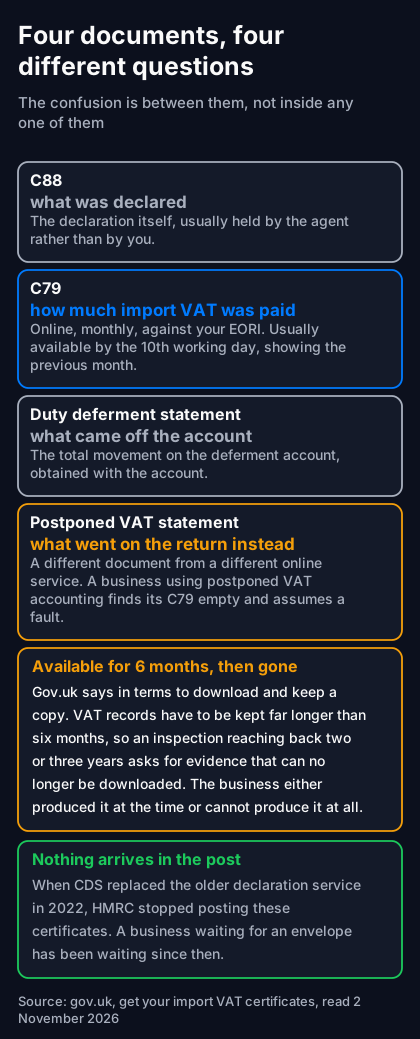
A C79 is HMRC's monthly certificate of the import VAT you have paid, and it is the evidence for reclaiming it. It appears online each month, usually by the 10th working day, covering the previous month, and it is accessible for only 6 months before it disappears from the service. Businesses using postponed VAT accounting get a different document entirely. This sets out which paper proves what, and why the official guidance is so hard to find.
What is a C79 certificate?
A C79 is HMRC's monthly certificate of the import VAT you have paid, and it is the evidence you need to reclaim that VAT. Gov.uk describes it plainly: your import VAT certificates will show how much VAT you have paid on imports.
It is a statement rather than a demand. Nothing on it asks for money — the money has already gone — and its only job is to prove to HMRC that the figure you are reclaiming on a VAT return was actually paid at the border.
That makes it a bookkeeping document with a deadline attached, which is an unusual and expensive combination. Miss it and the VAT is still paid; what you have lost is the ability to prove it.
The asymmetry is worth sitting with for a moment. Import VAT on a single container can exceed the margin on the goods inside it, and it is recoverable in full for a VAT-registered importer — so the certificate is not an administrative nicety but the paper that turns a cash outflow back into a neutral one.
When is it issued, and how do you get it?
Monthly, online, and you have to go and fetch it. Certificates are available every month, usually by the 10th working day, and each one shows the previous month in which import VAT was paid.
Access is by signing in with credentials linked to your EORI number — so the certificate belongs to the EORI that imported the goods, not to whoever paid the invoice. Our EORI article covers how that number is obtained and why it is the identifier everything hangs off.
The delivery model changed when the Customs Declaration Service replaced the older declaration system in 2022: HMRC stopped posting these certificates, and there is now no paper arriving to remind anybody. A business that is waiting for an envelope has been waiting since then.
What is the six-month trap?
A statement is only accessible for 6 months from the date it is published, and gov.uk says in terms to download and keep a copy. After that window the document is gone from the service.
That is the single most expensive sentence on the subject. VAT records have to be kept for far longer than six months, and an inspection reaching back two or three years will ask for evidence that can no longer be downloaded — so the business either produced it at the time or cannot produce it at all.
The fix is a monthly habit rather than a system: somebody downloads the certificate in the first half of each month and files it with the VAT records. Our customs value article makes the same point about apportionment workings, and the pattern is identical — the evidence is cheap to keep and impossible to recreate.
Who actually gets a C79?
Businesses that paid the import VAT, by a specific route. The certificate evidences import VAT paid through a duty deferment account, so it follows the payment mechanism rather than the shipment.
| How the import VAT was handled | What evidences it |
|---|---|
| Paid through a duty deferment account | The C79 import VAT certificate |
| Accounted for on the VAT return under postponed VAT accounting | A postponed import VAT statement, obtained separately |
Those are two different documents from two different places, and the commonest confusion in this area is expecting one to show the other. A business using postponed VAT accounting will find its C79 empty or absent and conclude something has gone wrong, when the figure it needs is on the postponed import VAT statement instead. Our import VAT and postponed VAT accounting article covers which route to choose.
Where does the C88 fit in?
It is the declaration, not the evidence of payment, and conflating the two is how reclaim claims get built on the wrong paper. The C88 is the form on which the import declaration was made — historically the Single Administrative Document.
So the two documents answer different questions. The C88 says what was declared; the C79 says what was paid. A reclaim supported by a C88 alone is supported by a statement of intent rather than a receipt.
In the Customs Declaration Service era most importers never see a C88 at all, because the declaration is data rather than a form and the agent holds the record. That is worth knowing before asking a forwarder for one: what you usually want is the entry reference and the C79, not a reproduction of a paper form.
What about the duty deferment statement?
A third document, and the one that reconciles the money. A deferment statement shows what was taken from the deferment account; the C79 shows the import VAT element of it; the two should agree, and when they do not, something in a declaration was wrong.
The reconciliation is the point. Duty, excise and import VAT all come off the same deferment account in one monthly collection, so the statement is the only place the total is itemised — and our duty deferment article covers how that account behaves and why its limit matters.
| Document | Question it answers | Where it comes from |
|---|---|---|
| C88 | What was declared? | The declaration, usually held by the agent |
| C79 | How much import VAT was paid? | Online, monthly, against your EORI |
| Duty deferment statement | What came off the account in total? | Online, with the deferment account |
| Postponed import VAT statement | What was accounted for on the return instead? | A separate online service |
Four documents, four questions, and a business that files all of them can answer anything HMRC asks about an import. One that files none is relying on its agent's records, which is a commercial arrangement rather than a compliance position — and agents change, lose tenders and go out of business while VAT records still have to be produced.
Why is this so hard to find?
Because the guidance that used to explain it was withdrawn and never properly replaced. VAT Notice 702 carried a section devoted entirely to the C79, and gov.uk withdrew the notice on 1 January 2021 as out of date.
What replaced it is a short how-to-sign-in page rather than an explanation, which is why the practical knowledge now lives in accountancy articles instead of official guidance. That is not a complaint — it is the reason a search for this term returns almost no competing commercial pages, and the reason it is worth writing down carefully.
It also means a reader should treat any older guide with suspicion. Anything written before 2021 describes a posted certificate and a notice that no longer exists, and anything written before October 2022 describes a declaration system that has been switched off.
What goes wrong in practice?
Four failures, and three are calendar failures rather than tax failures.
- Nobody downloads the certificate, and six months later the evidence is unavailable.
- The wrong document is sought — a C79 for a shipment handled under postponed VAT accounting.
- The EORI is not the importer's, so the certificate sits in somebody else's account entirely.
- The reclaim is built on the agent's invoice, which evidences what the agent charged rather than what HMRC received.
The third is the subtle one and it follows from how the certificate is accessed. Where goods were imported under a forwarder's or agent's EORI, the C79 belongs to them — and our customs value article covers why the importer of record question has to be settled before the first shipment rather than at the first audit.
What should an importer do each month?
Four steps, in the first half of the month, and the whole thing takes minutes.
- Sign in and download the certificate for the previous month.
- Download the postponed VAT statement too if any shipments used that route.
- Reconcile against the deferment statement, so a wrong declaration surfaces in weeks rather than years.
- File all of it with the VAT records, not in the mailbox of whoever happened to download it.
That cadence exists because of the six-month window and for no other reason. Any process that depends on remembering to look later is a process that will be tested by an inspection covering a period nobody looked at.
What is our part in this?
None of it, and that is worth being plain about: we are a carrier, not a customs agent and not a tax adviser. We do not hold a deferment account for customers' goods, we do not lodge declarations, and no document we issue is evidence of import VAT.
What our paperwork does evidence is the movement — collection, carriage and delivery — and that is a different question from what was paid at the border. Our proof of delivery article sets out exactly what a delivery record does and does not prove, and the distinction matters here: a signed delivery note is not evidence of a customs position.
For the border side of the same shipment see how long customs clearance takes and safety and security declarations; for what the figure was calculated on, customs value. Our customs page sets out where we coordinate with a broker and where we do not.
Questions
- What is a C79 certificate?
- HMRC's monthly certificate showing how much import VAT you have paid, and the evidence you need to reclaim it. It is a statement rather than a demand: the money has already gone, and the certificate's only job is to prove that the figure reclaimed on a VAT return was actually paid at the border. It evidences import VAT paid through a duty deferment account specifically.
- How do I get my C79 certificate?
- Online, by signing in with credentials linked to your EORI number. Certificates are available every month, usually by the 10th working day, and each shows the previous month in which import VAT was paid. HMRC stopped posting them when the Customs Declaration Service replaced the older declaration system in 2022, so nothing arrives to remind you — a business waiting for an envelope has been waiting since then.
- How long can I access a C79 for?
- Six months from the date it is published, after which it is gone from the service — and gov.uk says in terms to download and keep a copy. That is the expensive detail, because VAT records must be kept far longer than six months, so an inspection reaching back two or three years will ask for evidence that can no longer be downloaded. The business either produced it at the time or cannot produce it at all.
- Why is my C79 empty or missing?
- Usually because the import VAT was not paid the way the certificate covers. A C79 evidences import VAT paid through a duty deferment account; if postponed VAT accounting was used instead, the figure is on a postponed import VAT statement obtained separately. The other common cause is that the goods were imported under somebody else's EORI — a forwarder's or agent's — in which case the certificate sits in their account.
- What is the difference between a C79 and a C88?
- The C88 is the declaration, historically the Single Administrative Document; the C79 is the evidence of payment. One says what was declared, the other what was paid, so a reclaim supported by a C88 alone rests on a statement of intent rather than a receipt. Most importers never see a C88 now, because the declaration is data rather than a form and the agent holds the record.
- How does a duty deferment statement differ from a C79?
- The deferment statement shows everything taken from the deferment account — duty, excise and import VAT together in one monthly collection — while the C79 shows the import VAT element. The two should agree, and where they do not, something in a declaration was wrong. The statement is the only place the total is itemised, which makes it the reconciliation document rather than the evidence document.
- Why is there so little official guidance on the C79?
- Because the guidance that explained it was withdrawn. VAT Notice 702 carried a section devoted entirely to the C79, and gov.uk withdrew the notice on 1 January 2021 as out of date. What replaced it is a short sign-in page rather than an explanation, which is why the practical detail now lives in accountancy articles — and why any guide written before 2021 describes a posted certificate that no longer exists.
Explore more
More from the blog
- Incoterms 2020 Explained: All Eleven Rules and Who…
- Inland border facilities: what they do, and what ch…
- IOSS: who collects the EU VAT on a low-value parcel
- IPAFFS pre-notification: what the border needs befo…
- ISPM 15: when your pallet needs a stamp, and when i…
- Kerbside, tail lift or carried in: who unloads, and…