
CN22 vs CN23: postal customs forms, the £1,000 cap and the courier route
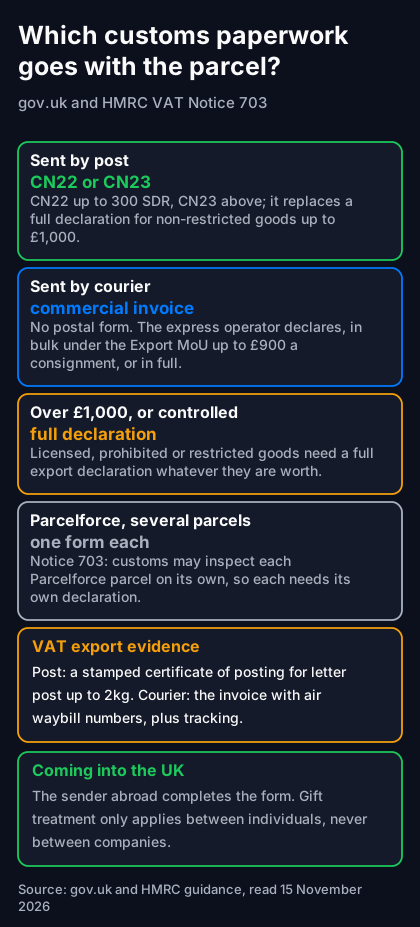
CN22 and CN23 are the Universal Postal Union's customs declaration forms, used in place of a full declaration for low-value parcels sent by post. They do not apply to courier or express shipments, which travel with a commercial invoice. This explains which form a parcel takes, where gov.uk requires one, the £1,000 cap on postal exports, the Export MoU that express operators use instead, and what VAT export evidence each route gives you.
What are CN22 and CN23?
They are the customs declaration forms of the Universal Postal Union (UPU), attached to each parcel a postal operator carries across a border. They record the contents at a high level: a description of the goods, their value and whether the item is a gift.
HMRC describes them as used in place of a full customs declaration for low-value, unrestricted goods sent by post, and gov.uk calls them item declaration forms. Both are available from any Post Office.
The key word is post. Both forms belong to the postal system run by designated operators, the national postal operators that fulfil their government's obligations under UPU agreements. The UK postal examples in HMRC's VAT guidance are Royal Mail and Parcelforce Worldwide.
Which one does my parcel need?
It depends on the value. HMRC, quoting UPU guidance, says a CN22 can be used for goods up to 300 SDR and a CN23 for goods over that value. The SDR (special drawing right) is a monetary unit used between postal operators, so the operator you post with converts the line into pounds; take the sterling figure from its current guidance, because a conversion printed elsewhere moves with exchange rates.
Gov.uk's CITES guidance puts the same rule plainly: the form you need depends on the value of the item. HMRC also notes that UPU rules set no upper value cap on either form; the £1,000 limit below is a limit on the export declaration, not on the form. Gov.uk is just as specific about where a form is required:
| Situation | What gov.uk requires |
|---|---|
| Exporting goods by post | CN22 or CN23 in place of a full declaration, up to £1,000 |
| Exporting CITES-listed specimens by post | CN22 or CN23, plus a C&E 83A label "exported by post under customs and excise control" |
| Posting CITES-protected plants or plant products into Great Britain | CN22 or CN23, plus the CITES permit or certificate |
| Ordering plants into Great Britain by post from outside the EU, Switzerland and Liechtenstein (and some listed species from the EU) | A phytosanitary certificate, which the seller includes with the item |
| Re-importing goods by post, VAT-registered | VAT number quoted on the CN22 or CN23 |
| Postal goods through a GVMS port | CN22 and CN23 item forms with CN37, CN38 and CN41 movement documents |
A courier or express shipment is not on that list: express operators declare goods by other means, set out below. For Parcelforce Worldwide parcels, Notice 703 adds that a fully completed customs declaration is required for every parcel, even when several parcels form one consignment, because customs may inspect each parcel on its own.
Is there a value limit on exporting by post with only a CN23?
Yes. Non-restricted goods up to and including £1,000 can leave the UK by post on the simplified declaration that the postal forms represent; above £1,000, a full export declaration is needed.
The gov.uk guidance for postal offices of exchange calls this a declaration by conduct, and lists exporting postal goods without an exit summary declaration among the things an approved office of exchange may do. HMRC's consultation on post and parcel exports traces the cap to the Customs (Exports) (EU Exit) Regulations 2019, which set it at £900 before a 2021 amendment raised it to £1,000.
The cap is per consignment and applies only to goods that are not controlled. Anything that needs an export licence, or is subject to prohibitions or restrictions, needs the full declaration whatever its value; our export licence article sets out how to check.
Do couriers use CN22 and CN23?
No. CN22 and CN23 are postal forms. An express operator declares the goods itself, in bulk under the Export MoU or by a full declaration, and the shipment travels with a commercial invoice and an air waybill number rather than a postal form.
That is where a lot of confusion comes from. Online sellers who start with Royal Mail learn the CN23 and look for it again when they switch to an express service, and the express operator asks for a commercial invoice instead. The data is much the same; the document and the route are different.
| By post | By express or courier | |
|---|---|---|
| Customs document on the parcel | CN22 or CN23 | Commercial invoice |
| Export declaration | Declaration by conduct, up to £1,000 | Bulk declaration under the Export MoU, or a full declaration |
| Who declares | The postal route | The express operator or a customs agent |
| VAT export evidence | Certificate of posting or Parcelforce receipt | Invoice with air waybill numbers, plus tracking |
What is the Export MoU?
The Export Memorandum of Understanding is an agreement between HMRC and authorised express operators, in place since 2003, that lets them bulk-declare qualifying low-value consignments instead of declaring each one in full.
The value cap is £900 per consignment. The operator enters the details in its own records before export, a process called entry in the declarant's records (EIDR), and can declare for many traders in a single declaration without item-level data for each parcel. HMRC estimated about 170 million items left the UK this way in 2021.
Not everything qualifies. The goods must be in free circulation, must not be controlled, prohibited or restricted, and must not be under another customs procedure such as temporary admission, inward processing, customs warehousing or outward processing; goods coming back after repair are covered in our outward processing article. Qualifying goods must also pass through the approved operator's own facility.
What has to go on the form?
A full and clear description of every item, with its quantity, weight and value, and whether it is a gift. Notice 703 asks Parcelforce senders for a full description with quantity, weight and value, gov.uk's CITES guidance asks for whether the goods are gifts or commercial items, and a vague entry such as "parts" leaves customs nothing it can check.
- Description: what the item is and what it is made of, specific enough that someone could classify it.
- Quantity and weight for each line, not just the total.
- Value for each line, in a stated currency.
- Gift or not: gift treatment only applies between individuals, so goods a business sends are declared as what they are.
- Commodity code and origin where the form asks for them; see our commodity code explainer.
Notice 703 is blunt about the risk: if goods are described inaccurately on an export declaration, the sender may be liable for a customs penalty. How the value itself is built up is covered in customs value.
How do you prove a postal export for VAT?
With evidence of posting. Under VAT Notice 703, goods exported by post can be zero-rated if they are direct exports and you hold the evidence that they were posted to an address outside the UK.
For letter post or airmail packages up to 2kg, that evidence is a certificate of posting stamped by the Post Office: form C&E132 for one or more packages, form P326 for a single package, a Certificate of Posting for International Mail, or a Royal Mail Collection Manifest signed by the collection driver.
For Parcelforce Worldwide parcels, it is the customs declaration completed for each parcel, on paper or online, together with the receipt copy and the Post Office proof of shipment showing the overseas address, date and consignment number. Regular account customers can add a manifest or statement of account listing each export.
And for a courier export?
The invoice for the shipment, which normally carries the air waybill number of each consignment, is the normal commercial evidence of export, because most courier and fast parcel operators do not issue a separate certificate of shipment.
Notice 703 adds that tracking printouts can confirm the goods have left the UK, and warns that an untracked service makes it hard to show that specific goods were exported. If your overseas customer arranges the courier, find out before the goods leave what proof of export they will give you. The air waybill itself is explained in our waybill article.
What if the parcel is coming into the UK?
The same forms travel the other way. The sender abroad completes the customs declaration, and the parcel or courier company takes the goods through UK customs and tells the recipient if any VAT or duty is due.
Gov.uk lets the recipient declare the goods instead, if the sender writes "goods to be declared by importer" on the form, but warns this can delay the goods by at least 4 weeks. Gift treatment only applies when the goods are described as gifts on the declaration and are sent between individuals, not companies, so a business cannot use it. The gov.uk page on goods sent from abroad has the detail, and our import VAT article covers business imports.
What should you check before a parcel goes?
Four things, in this order: the route, the value, the goods and the evidence. Most problems with postal declarations trace back to one of them being assumed rather than checked.
- Route: post or courier. A CN23 on a courier shipment does nothing; a courier wants an invoice.
- Value: over £1,000, or controlled goods at any value, means a full export declaration, not a postal form.
- Goods: CITES-listed specimens need their CITES documents as well as the form, and plants coming in from outside the EU, Switzerland and Liechtenstein (plus some listed species from the EU) need a phytosanitary certificate.
- Evidence: keep the certificate of posting, Parcelforce receipt or courier invoice for VAT, and a copy of every form.
For Parcelforce, each parcel of a multi-parcel consignment needs its own completed declaration, so a form on the first box only leaves the rest undeclared. For VAT-registered senders re-importing goods by post, the VAT number belongs on the form.
Where do we stand in this?
Outside the postal system. T&C Logistics is not a postal operator and not an Export MoU express operator, so we do not issue or accept CN22 or CN23 forms, and we hold no customs-broker or customs-agent status.
Our work is moving goods by road and to and from airports. Where a consignment needs a customs declaration, it is lodged by one of our licensed partner customs brokers, working from your commercial invoice, and the export evidence you keep is the invoice and the carrier's documents described above. The description, commodity code and value on that invoice are the same data a postal form asks for, so getting them right once serves either route.
Questions
- Should I use CN22 or CN23?
- It depends on the value. HMRC, quoting UPU guidance, says a CN22 can be used for goods up to 300 SDR and a CN23 for goods over that value. The SDR is a monetary unit used between postal operators, so take the sterling equivalent from the operator you post with. Both forms record a description, the value and whether the item is a gift.
- Do I need a CN23 if I send with a courier?
- No. CN22 and CN23 are postal forms. An express operator declares the goods itself, in bulk under HMRC's Export MoU or by a full declaration, and the shipment travels with a commercial invoice and an air waybill number. The information is much the same: a clear description, quantity, weight and value.
- Is there a value limit for exporting goods by post from the UK?
- Yes. Non-restricted goods up to and including £1,000 can be exported by post on a simplified declaration, which gov.uk calls a declaration by conduct. Above £1,000, or for goods that are controlled, prohibited or restricted, a full export declaration is needed. The cap comes from the Customs (Exports) (EU Exit) Regulations 2019.
- What is the Export MoU?
- An agreement between HMRC and authorised express operators that lets them bulk-declare qualifying consignments worth up to £900 each, entering the details in their own records before export. The goods must be in free circulation, not controlled or restricted, and not under another customs procedure, and they must pass through the operator's approved facility.
- How do I prove a postal export for VAT zero-rating?
- VAT Notice 703 requires evidence of posting to an address outside the UK. For letter post or airmail up to 2kg that is a certificate of posting stamped by the Post Office, such as form C&E132 or P326. For Parcelforce parcels it is the completed customs declaration for each parcel, the receipt copy and the proof of shipment.
- Does every parcel need its own customs declaration?
- For Parcelforce Worldwide, yes. VAT Notice 703 says a fully completed customs declaration is required for every Parcelforce parcel, even when several parcels make up one consignment, because customs may inspect each parcel on its own. A form on only the first box of a multi-parcel shipment leaves the others without a declaration.
- Can a business use gift treatment on a CN22?
- No. Gov.uk says that to qualify as gifts, goods must be described as gifts on the customs declaration, be for an occasion such as a birthday or anniversary, be sent between individuals rather than companies, and be for personal use. A business sending samples or stock should declare them as what they are.
Explore more
More from the blog
- Tachographs: who needs one, and the van rule that c…
- Temperature mapping: what it establishes, and whose…
- UN3480 vs UN3481: which number applies to your lith…
- What a Van Can Legally Carry: Gross Vehicle Weight,…
- Van payload: why a 3.5 tonne van cannot carry 3.5 t…
- Waste carrier registration: who needs one, and what…