
Plastic Packaging Tax: who pays, and what it means for imports and pallet wrap
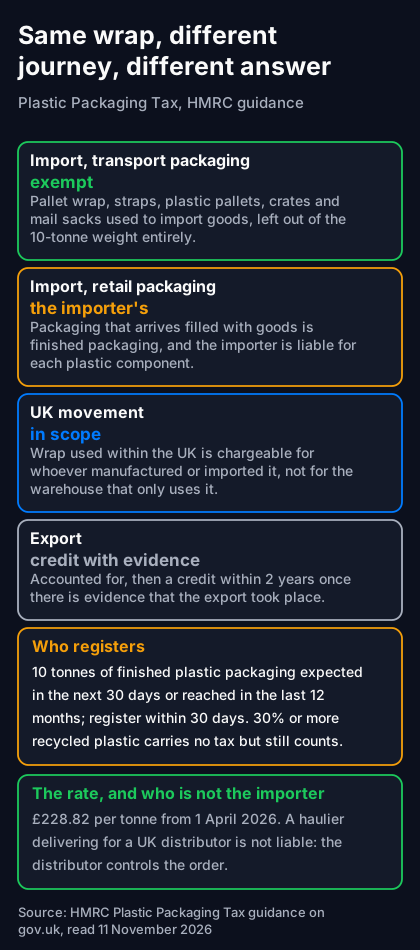
Plastic Packaging Tax is charged on finished plastic packaging made in or imported into the UK with less than 30% recycled plastic, at £228.82 per tonne from 1 April 2026, once a business reaches 10 tonnes. For anyone who ships goods, the surprises are logistical: packaging on imported goods counts, pallet wrap is exempt only on imports, and HMRC says the haulier is not the importer. This sets out who registers, what is exempt, and how exports get the tax back.
What is Plastic Packaging Tax?
Plastic Packaging Tax is a UK tax, in force since 1 April 2022, on finished plastic packaging components manufactured in or imported into the UK that contain less than 30% recycled plastic. HMRC runs it, and it is charged per tonne of chargeable packaging.
Three words in that definition do most of the work. "Finished" means the component has had its last substantial modification, such as extrusion, moulding or printing. "Imported" includes packaging that arrives already filled with goods. And "plastic" means a component where plastic is the heaviest single material by weight, so a carton of 4 grams of plastic, 3 of aluminium and 3 of cardboard counts as plastic in full.
Biodegradable, compostable and oxo-degradable polymers are still plastic for the tax. So is cellulose acetate; unmodified cellulose such as viscose is not.
Who has to register?
A business that manufactures in or imports into the UK 10 tonnes or more of finished plastic packaging components, measured by either of two tests, per HMRC. Meeting either test means registering; meeting both means registering from the earlier date.
| Test | How it works | Liable from |
|---|---|---|
| Look forward | Expect 10 tonnes or more in the next 30 days | The date you had reason to expect it |
| Look back | 10 tonnes or more in the last 12 months, checked from the last day of each month | The first day of the following month |
| Deadline | Register within 30 days of becoming liable | Tax is due on everything from the liability date |
HMRC's own example of the forward test is the one that catches people: a manufacturer making 0.25 tonnes a month takes a 20-tonne order on 16 May, becomes liable that day, and owes tax on its normal production from then as well as the new order.
Below the threshold there is still a job to do. A business that is not required to register should keep records showing it manufactures or imports less than 10 tonnes a year, filled packaging included.
How much is the tax?
£228.82 per tonne from 1 April 2026. The rate has risen every April since the tax began, so an old figure in a supplier's terms or a budget spreadsheet is a sign the document is out of date.
| From | Rate |
|---|---|
| 1 April 2022 | £200 per tonne |
| 1 April 2023 | £210.82 per tonne |
| 1 April 2024 | £217.85 per tonne |
| 1 April 2025 | £223.69 per tonne |
| 1 April 2026 | £228.82 per tonne |
The rate applies only to chargeable components. A component with 30% or more recycled plastic carries no tax, but it still counts towards the 10-tonne threshold and still has to be recorded, which is why a business can be registered and owe little.
Does it apply to goods I import, not just packaging?
Yes. Plastic packaging that arrives already filled with goods is treated as finished packaging, and the importer is liable for each plastic component around those goods: the bottle, the cap, the tray, the film.
This is the part importers most often miss. A retailer that buys no packaging at all, but imports finished products in plastic retail packaging, can cross 10 tonnes on the weight of that packaging alone. The tax becomes chargeable once the goods have cleared all customs procedures, so it sits alongside the duty and VAT questions in our customs value and import VAT articles rather than replacing either.
It is not collected at the border, though. The tax is chargeable at import but accounted for quarterly in arrears on the importer's own return.
Who counts as the importer?
Generally the consignee on the import documents, unless the consignee can show it is acting for someone else who controls the import. HMRC's guidance on finished components gives the example a carrier would choose: a haulier delivering plastic packaging into the UK for a UK distributor is not liable, because the distributor controls the order.
A consignee that believes it is not the importer still has a duty. HMRC treats checking that the real importer is accounting for the tax as part of the consignee's own due diligence.
Incoterms do not settle it on their own. Where finished packaging is imported under an Incoterms rule, HMRC expects the businesses involved to agree who includes it on their return and pays; our Incoterms 2020 guide covers what the rules do and do not allocate.
Is pallet wrap taxed?
It depends on the journey, not the wrap. HMRC lists pallet wrap and shrink wrap as packaging in scope of the tax, and exempts them only as transport packaging on goods being imported into the UK, per its exemptions guidance.
| Use of the plastic | Chargeable? |
|---|---|
| Pallet wrap and straps on an inbound import | No — transport packaging exemption |
| Plastic pallets, crates and containers on an import | No, where used as transport packaging |
| Pallet wrap on a domestic UK movement | In scope for whoever manufactured or imported the wrap |
| Transport packaging on an export | Accounted for, then a credit can be claimed with export evidence |
| Intermediate bulk containers, on any journey | Not covered by the exemption |
| Unfilled transport packaging imported as goods in its own right | Not covered by the exemption |
The tax falls on manufacture or import, so a warehouse that buys UK-made wrap from a supplier and uses it neither manufactures nor imports it. The exemption also does not count towards the 10-tonne threshold, unlike the medicines one, so transport packaging on imports can be left out of the weight entirely. For how the load has to be held once it is wrapped, see load securing.
What about reusable crates and pallets?
Two routes take them out of the tax on import. Reusable plastic crates, boxes and pallets used as transport packaging on an import fall under the exemption above, and reusable packaging brought in under Temporary Admission is not subject to the tax either.
Inside the UK the position changes. HMRC lists reusable plastic crates designed to deliver fresh fruit or baked goods as in scope, so a crate pool supplied from UK manufacture is chargeable at the point of manufacture unless it contains 30% or more recycled plastic. Temporary Admission is one of the special procedures in our customs special procedures article, and who owns a returnable pallet is its own question in pallet exchange.
Which packaging is exempt or excluded?
Four exemptions and three exclusions, and the difference matters for the 10-tonne threshold.
- Immediate packaging of licensed human medicines — exempt, but counts towards the threshold. The medicine must be licensed by the MHRA.
- Packaging permanently recorded as set aside for non-packaging use — exempt, counts towards the threshold, and must be recorded at or before manufacture or import.
- Transport packaging used to import goods — exempt and left out of the threshold.
- Stores on international aircraft, ships and trains — exempt and left out of the threshold.
- Excluded: packaging designed for long-term storage (a toolbox, a first aid box), packaging that is an integral part of the goods (a printer cartridge, an inhaler), and packaging reused to present goods (a display stand).
None of these turns on the type of plastic. HMRC is explicit that the transport and stores exemptions are decided by how the packaging is used, which is why the same kind of wrap can be exempt on an inbound pallet and chargeable on an outbound one.
Can you get the tax back on exports?
Yes, with evidence. A registered business can claim a credit for components it paid tax on and that were later exported, by it or by another business, within 2 years of their manufacture or import.
Two other routes exist. Components exported in the same accounting period come off that period's bill, and a business that intends, before manufacture or import, to export components within 12 months can defer the tax and have the liability cancelled once the export happens.
The evidence is where logistics comes in. HMRC accepts a document used for another tax or duty, or another document such as an export invoice, that identifies the components exported, and it may have to come from the exporting business. Cancelling a deferred liability also needs the weight exported and the date of export. Our commercial invoice article covers the document most exporters already produce.
What records does the tax need?
Accounts by product line, kept for 6 years from the end of the accounting period. A product line is a group of plastic packaging components made to the same specification.
HMRC lists the documents that can carry the evidence: production specifications, contracts, certificates of conformity, quality audits, and sales and purchase invoices. For imported packaging claiming 30% recycled content, the evidence has to come from the manufacturer or from a robust supply-chain audit, because all plastic is assumed virgin unless shown otherwise.
The registration test needs its own record too. Whichever way the 10-tonne answer comes out, HMRC expects a note of how it was worked out.
Where do we stand in this?
We are a carrier, so when we move a consignment we are neither the manufacturer nor the importer of the packaging around it, which is the position HMRC's haulier example describes. We do not register for, calculate or advise on Plastic Packaging Tax; HMRC's steps to take and an accountant are the right sources for that.
A carrier's paperwork can support the trail without replacing it: a collection and delivery record shows when goods moved, but the export evidence HMRC asks for is the exporter's document, not ours. For the other packaging regime, which charges brand owners and importers for disposal rather than for plastic content, see our EPR for packaging article. For moving plastic stock itself, see plastics distribution, and our licences page lists what we do hold.
Questions
- What is the Plastic Packaging Tax threshold?
- 10 tonnes of finished plastic packaging components manufactured in or imported into the UK, measured two ways: expecting 10 tonnes or more in the next 30 days, or having reached 10 tonnes in the last 12 months. Meeting either test means registering with HMRC within 30 days of becoming liable. Components with 30% or more recycled plastic still count towards the 10 tonnes.
- What is the Plastic Packaging Tax rate for 2026?
- £228.82 per tonne from 1 April 2026, up from £223.69 per tonne in 2025. The rate has risen every April since the tax started at £200 per tonne on 1 April 2022. It applies only to components with less than 30% recycled plastic.
- Is pallet wrap subject to Plastic Packaging Tax?
- Pallet wrap is in scope, but it is exempt as transport packaging when it is used to import goods into the UK. The same wrap used on a domestic movement or an export is not covered by that exemption. On exports, the business that paid the tax can claim a credit once it holds evidence that the export took place.
- Do I pay Plastic Packaging Tax on imported goods?
- If you import goods in plastic packaging, the packaging is treated as finished and you are liable for each plastic component once your total reaches the 10-tonne threshold. The tax is chargeable when the goods clear customs, but it is accounted for quarterly in arrears on your own return rather than paid at the border.
- Is the haulier liable for Plastic Packaging Tax?
- Not merely for delivering it. HMRC's example is a haulier bringing plastic packaging into the UK for a UK distributor: the distributor is liable because it controls the order. The importer is generally the consignee on the import documents, and a consignee that is not the importer should check that the real importer is accounting for the tax.
- What packaging is exempt from Plastic Packaging Tax?
- Four categories: immediate packaging of licensed human medicines, packaging permanently set aside for non-packaging use, transport packaging used to import goods, and stores on international aircraft, ships and trains. Separately, packaging designed for long-term storage, packaging integral to the goods and packaging reused for presentation are excluded. Only the first two count towards the 10-tonne threshold.
- Can I claim Plastic Packaging Tax back on exports?
- Yes. A registered business can claim a credit for components it paid tax on that were later exported, by itself or another business, within 2 years of manufacture or import. It needs evidence that the export took place, such as an export invoice or a document used for another tax or duty, identifying which components were exported.
Explore more
More from the blog
- EORI Number Explained: GB, XI, and Who Actually Nee…
- EPR for packaging: who is obligated, what they repo…
- EUDR: what the EU Deforestation Regulation asks of…
- GVMS and the Goods Movement Reference Explained
- Hiring a refrigerated van versus using a carrier: w…
- Incident hardware delivery: what to arrange before…